FVG makes the PCBA, wire harness and silicone parts, builds them into a tested module, and delivers it ready to ship. One group, one quality system, one point of accountability.
Start a Programme ReviewFrom Individual Parts to One Ship-Ready Module

FVG manufactures electronic, interconnect and elastomer components for critical automotive systems, and integrates them into finished modules.
SOLUTIONS BY VEHICLE SYSTEM

Engine & Powertrain
Electronic and interconnect assemblies built for demanding operating environments, with environmental and reliability testing in-house
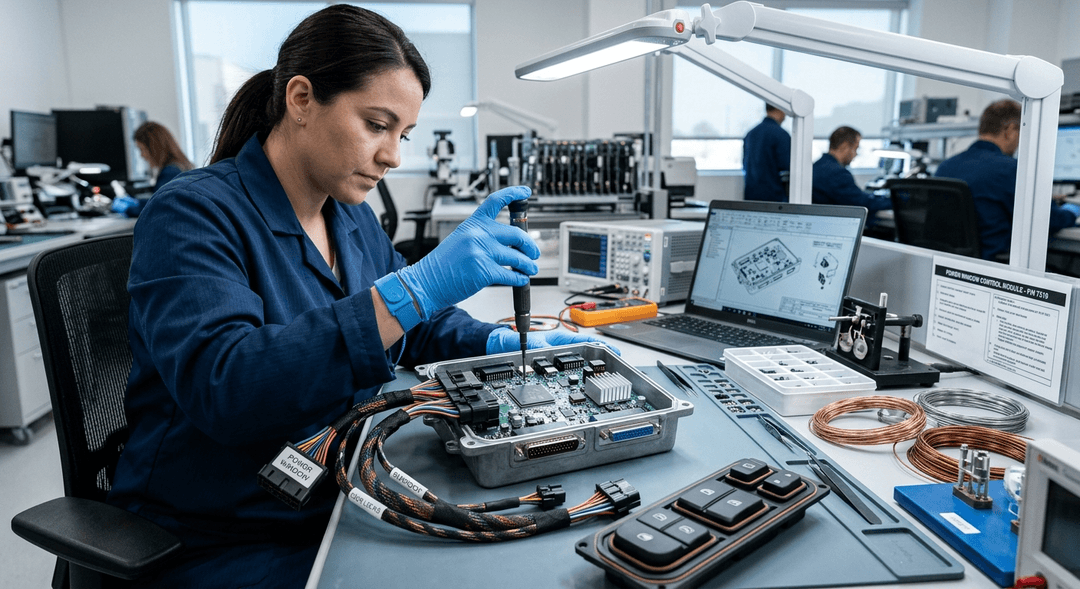
Body Electronics
PCBA, wire harness and component assembly for body control systems from one partner
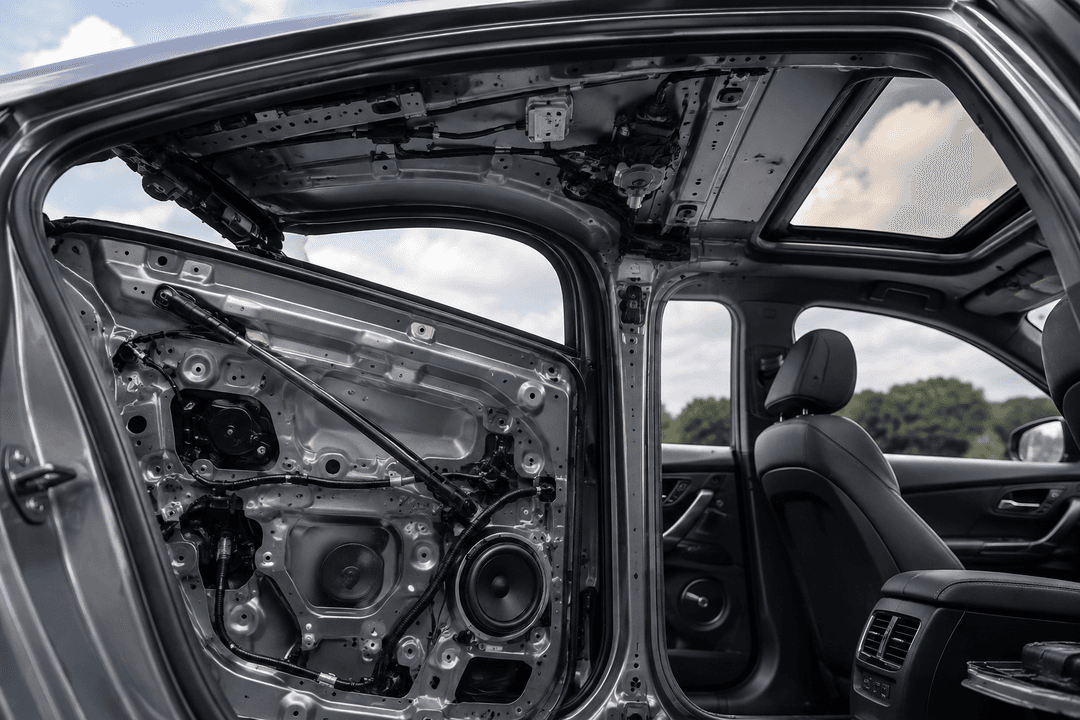
Door & Roof Systems
Precision components and assemblies for power windows, door controls and sunroofs, with durable sealing built into the same module

Instrument Panels & HMI
Electronic assemblies and silicone components for clusters, switches and keypads, including backlit keypads with integrated light guides
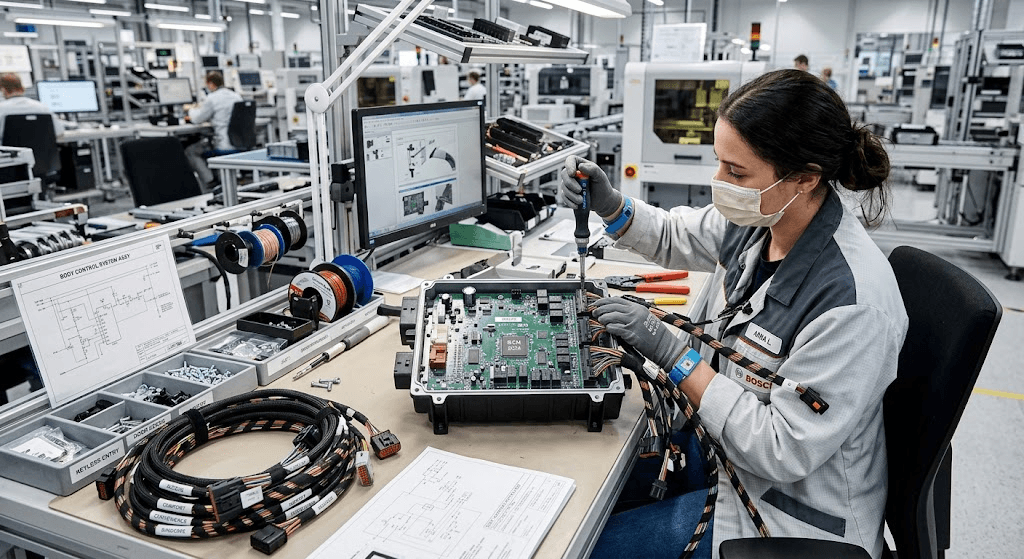
Sensors & Control Modules
Sensor assemblies and control modules with PCBA, interconnect and precision component integration, tested together
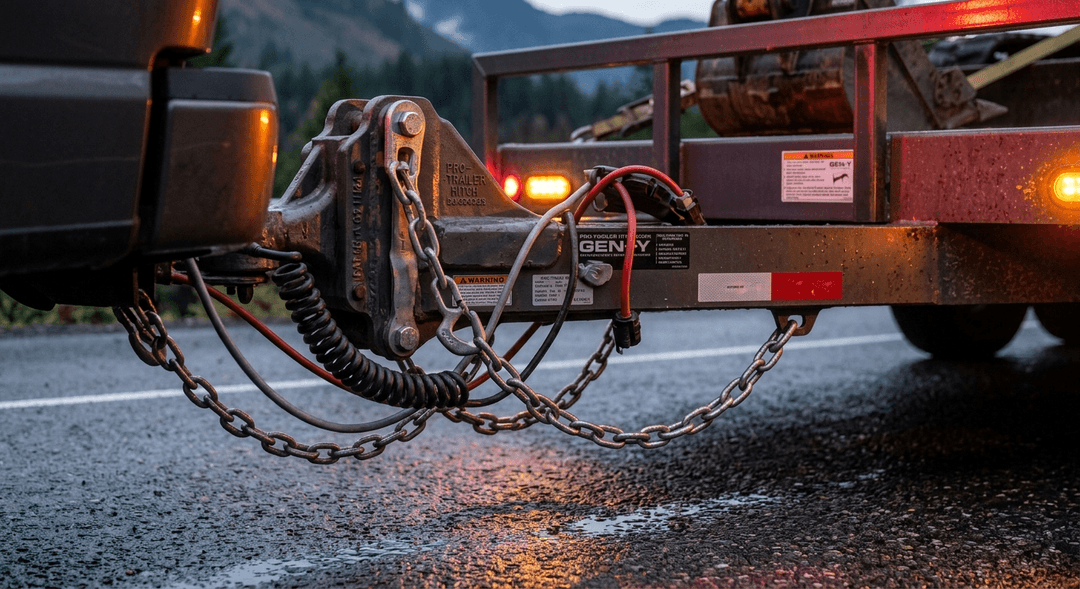
Lighting & Tow Systems
Electronic and interconnect solutions for lighting, trailer and towing systems, including sealed 7-way tow connector assemblies
Manufacturing services
Most EMS providers start at assembly. We start at the part.
A conventional EMS buys finished parts and assembles them. FVG fabricates the parts too, then carries the product through to a tested, ship-ready module. Each stage you move up removes a supplier interface, a margin layer and a lead-time buffer.
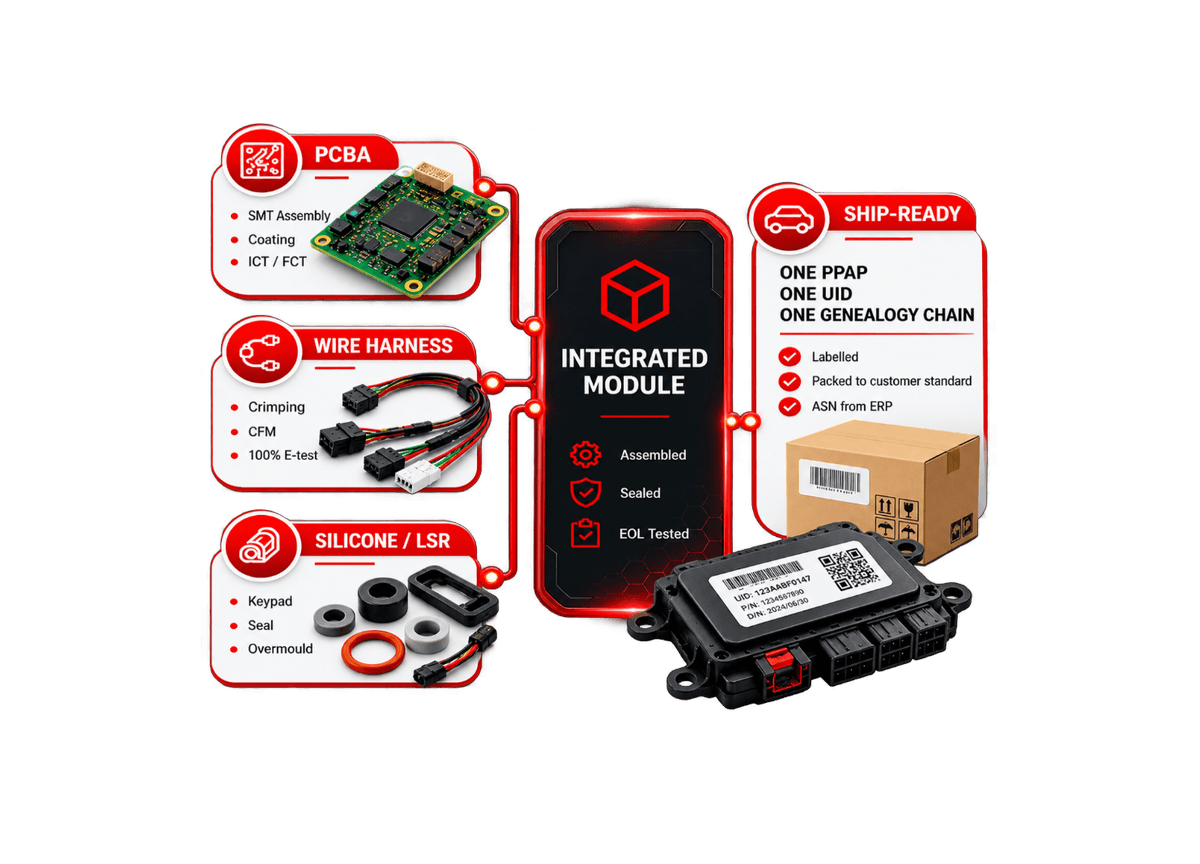
Components & parts
SMT and PCBA, precision injection moulding and tooling, metal machining and stamping, cable and wire harness, silicone/LSR parts.
Sub-assemblies & modules
Beyond individual components, FVG provides complete module integration—assembling, sealing and end-of-line testing the finished unit. This reduces supplier complexity, improves traceability and gives OEMs a single manufacturing partner responsible for the complete module.
Ship-Ready, Customer-Specific Delivery
Modules arrive labelled, packed to your specification, with UID genealogy and an ERP-generated ASN. One PPAP, one UID, one genealogy chain.
PCBA, wire harness and silicone capabilities
WHAT GOES INSIDE THE MODULE
Whether it's a single-circuit sensor lead, a multi-circuit harness terminating directly onto a PCBA, or the moulded silicone keypad and seal that complete the module, each process is run under one quality system and one traceability record.
Electronics - PCBA & Electronic Module Assembly
Placement, Reflow and Through-Hole Assembly
SMT and mixed-technology assembly from 0201 chip components to fine-pitch QFN and BGA, plus selective and wave solder, press-fit and certified hand-solder rework. Built to IPC-A-610 Class 2 or 3, soldered to J-STD-001.
Inspection and Test
Solder-paste inspection, AOI, X-ray for BGA voiding, ICT / flying probe, functional and end-of-line test, boundary scan, burn-in and run-in. Every result is captured against the unit serial.
Environmental Protection
Selective conformal coating, potting, gap-fill and thermal-interface application for underhood and exterior-duty modules, with MSL floor-life tracking and an ESD program to ANSI/ESD S20.20.
Interconnect - Wire Harness & Cable Assembly
UL-Verified Wire and Terminal Selection
Matched to voltage, temperature and flame-performance needs.
Precision Crimping and Termination
With crimp-force monitoring on every terminal, pull-force testing, crimp-height measurement and cross-section micrographs to a defined sampling plan.
Custom Harness Design, Routing and Test
Multi-circuit routing, shielding and strain relief; sealed and unsealed connector systems including 7-way tow connectors; 100% continuity, short/open, polarity and hipot testing, inspected to IPC/WHMA-A-620.
Elastomer - Silicone Rubber & LSR Moulding
Moulding, Tooling and Multi-Material Overmoulding
LSR injection and HCR compression/transfer moulding with in-house tool design; two-shot and insert overmoulding to plastic, metal and PCB carriers, including backlit keypads with laser-etched legends.
Sealing and Environmental Duty
Gaskets, grommets, boots, bellows, strain reliefs and cable overmoulds for IP-rated joints, rated for typical service from −50°C to +200°C.
Dimensional and Functional Validation
Dimensional inspection, force-travel curve capture and actuation-life testing, with post-cure verified on every batch.
Also in-house for automotive programmes
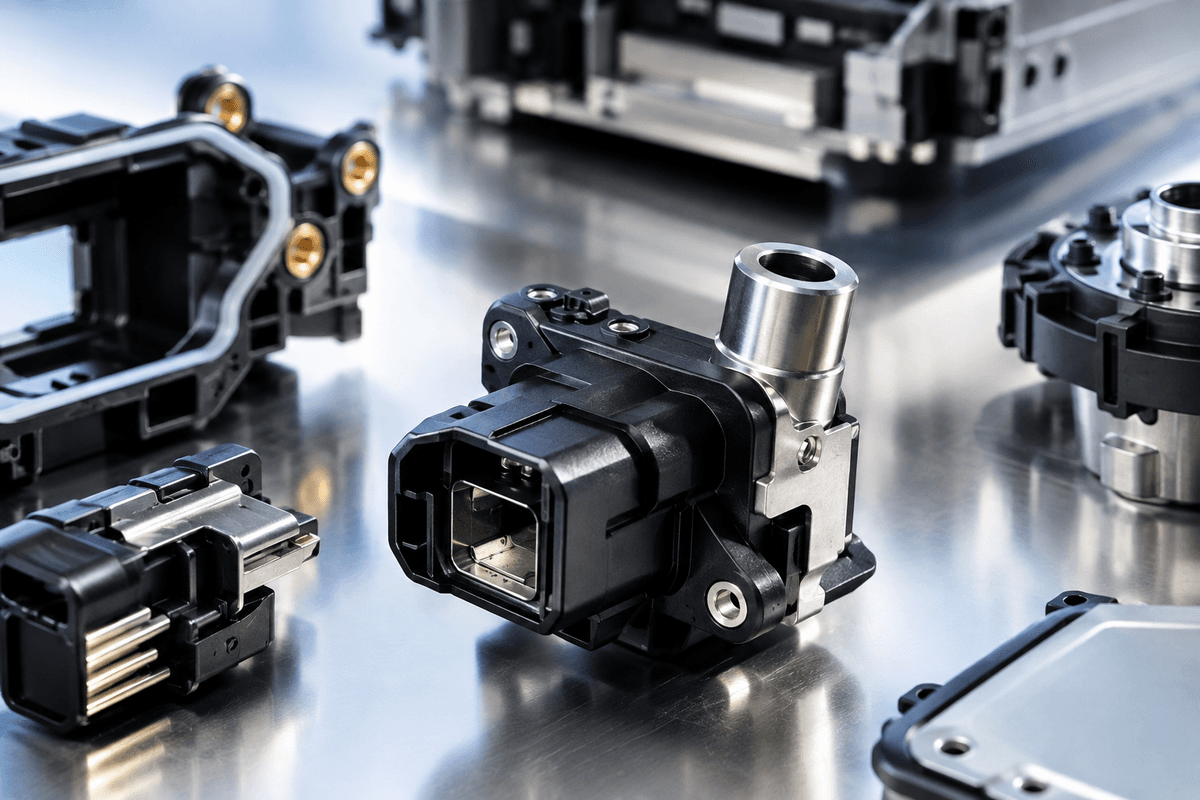
Injection moulding and tooling for plastic housings
Precision metal machining and stamping
Firmware load, calibration and configuration
Burn-in, extended stress, and environmental and reliability test
Aftermarket repair and reverse logistics
From RFQ to sustaining production, run by the group that will build it
HOW A PROGRAMME RUNS
One gated path, owned by the same team that builds the product. The cost model quoted at Gate 2 is the cost model the factory is measured against.
G1. Feasibility position and make/buy split
RFQ & feasibility: drawing, BOM and XYRS review, process route and capability screen
G2. Transparent should-cost quote
Quotation & cost model: standard time, UPH, manpower sizing, full landed cost
G3. Design change list and test strategy
DFM / DFT review with your engineers
G4. First articles and dimensional report
Tooling & prototype: tool design and cut, fixtures, jigs, first articles
G5. Cpk and PPAP approval
Pilot run & qualification: process validation, capability study, PPAP
G6. Stable rate at agreed KPIs
Mass production: rate ramp, SPC, IPC-1782 traceability, OTD/yield reporting
G7. Year-on-year cost reduction
Sustaining & cost-down: annual productivity, VA/VE, resourcing, lifecycle/EOL
Quality you can take into your PPAP
Automotive-Grade Quality & Reliability
Our processes are aligned with IATF 16949 and supported by IPC-A-610, IPC/WHMA-A-620 and J-STD-001. APQP, PPAP, SPC and MSA discipline is applied to automotive programmes, and a single quality agreement covers the part, the module and the shipment. One PPAP. One UID. One genealogy chain. Material lot to finished serial across every internal stage.
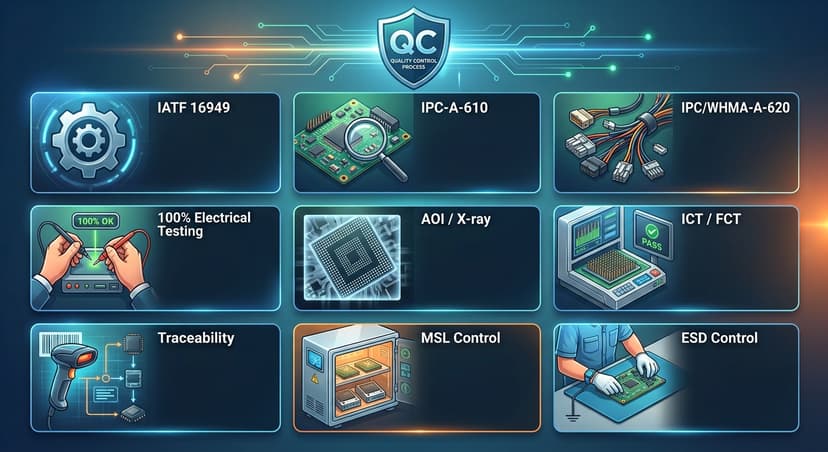
IATF 16949
Our quality management system follows IATF 16949 automotive requirements, focusing on defect prevention, process consistency, risk management, and continuous improvement to deliver reliable automotive components and modules.
IPC-A-610
IPC-A-610 defines the workmanship and acceptance criteria for electronic assemblies, ensuring PCBA soldering, component placement, cleanliness, and assembly quality meet recognized industry standards.
IPC/WHMA-A-620
IPC/WHMA-A-620 provides quality requirements for wire and cable harness assemblies, covering crimping, terminals, connectors, insulation, routing, and overall workmanship.
100% Electrical Testing
Every applicable assembly undergoes 100% electrical testing to verify continuity, connections, polarity, resistance, insulation, and other defined electrical parameters before shipment.
AOI / X-ray
AOI and X-ray inspection provide automated and non-destructive inspection of PCBAs, detecting visible and hidden defects such as component placement issues, solder defects, voids, and BGA-related problems.
ICT / FCT
ICT and FCT verify both circuit integrity and product functionality. ICT checks the assembled circuit, while FCT confirms the completed product performs according to its intended specifications.
Traceability
Our traceability system links materials, components, production processes, operators, inspection results, and test data to the finished product, enabling complete product history and genealogy when required.
MSL Control
Moisture Sensitivity Level (MSL) control protects moisture-sensitive electronic components through controlled storage, handling, exposure-time monitoring, and appropriate drying processes to prevent moisture-related defects.
ESD Control
Our ESD-controlled manufacturing environment protects sensitive electronic components from electrostatic discharge through grounded workstations, ESD-safe equipment and packaging, personnel controls, and regular monitoring.
Group-wide ISO 9001 and ISO 27001
Protection of customer design data and IP
Tier-1 & Tier-2 automotive build partner
Tier-1 & Tier-2 automotive build partner
Every switch, harness and seal — from one supply chain.
FVG builds the electronics, the wiring and the silicone that go inside North American passenger cars and the trailers they tow — assembled, tested and traced under one IATF 16949 quality system.
Vehicles are becoming more instrumented, more electrified and more dependent on real-time sensor data. This shift demands PCBAs, wire harnesses and sealing components that balance signal integrity with long-term durability, vibration resistance and electrical reliability in demanding on-road and off-road conditions — and the trailers those vehicles tow, which carry a second lighting and interconnect system of their own. Our vertically integrated model brings PCBA assembly, wire harness manufacturing and silicone moulding together on one factory floor, so the interface between them is resolved as an internal drawing rather than managed across separate suppliers. From design through development and delivery, we make sure the switch modules, sensor harnesses and silicone parts powering critical vehicle systems meet strict dimensional tolerances, withstand demanding thermal and vibration conditions, and deliver consistent electrical performance — because our success depends on our customers' success in their products.
FAQs
Frequently Asked Questions
Does Flexi Versa Group provide wire harness manufacturing?
Yes. At Flexi Versa Group, we manufacture wire and sensor harnesses requiring verified wire and terminal selection, controlled crimping, and precise electrical performance for automotive and heavy-duty vehicle applications.
Can Flexi Versa Group integrate wire harnesses directly with PCBAs?
Yes. We provide manufacturing solutions for harnesses engineered for direct integration onto PCBAs, including connector compatibility, signal testing and functional validation.
Can FVG support dual-site or alternative-origin production?
Yes, where the programme requires it. The group operates in five countries on one ERP, and qualification is scoped at feasibility.
What types of automotive modules does Flexi Versa Group manufacture?
Our capabilities include console and body switch modules, sensor and body harnesses, sealed trailer lighting and tow interfaces, and backlit silicone keypads and sealing components.
Can Flexi Versa Group mould the silicone components that pair with its PCBAs and harnesses?
Yes. We manufacture LSR-injected and HCR-moulded keypads, seals and gaskets, including two-shot overmoulding, in the same facility as the PCBA and harness lines they pair with.
Why consolidate PCBA, harness and silicone with one partner?
It removes supplier interfaces, so engineering changes, quality escalation and delivery sit with one team. Typically 2–4 supplier tiers are removed for a moulded-and-electronic product.
Can Flexi Versa Group support low-volume, high-mix production?
Yes. Our flexible manufacturing capabilities support specialised PCBAs, harnesses and silicone components for evolving production requirements.
Why does quality-system certification matter for automotive PCBA and harness work?
IATF 16949 certification confirms that wire, terminals, PCB assembly processes and moulding methods meet applicable safety, voltage and temperature requirements — reducing the risk of qualification delays, redesigns and compliance issues during production.
How does Flexi Versa Group ensure traceability for PCBAs, harnesses and silicone parts?
At Flexi Versa Group, we implement unit serialisation, quality validation testing and manufacturing process controls aligned to IPC-1782 to provide end-to-end traceability throughout the product lifecycle.
Can Flexi Versa Group support high-vibration and high-temperature environments?
Yes. We manufacture harnesses and silicone components engineered for vibration resistance and high-temperature environments, including engine-bay, exhaust and chassis-mounted applications.
Does Flexi Versa Group support signal integrity testing between the harness and the PCBA?
Yes. We test completed harnesses and PCBAs together — including continuity, insulation resistance and functional testing — to confirm accurate signal transmission.
How does Flexi Versa Group help manufacturers scale from prototype to production?
One gated path from RFQ through DFM, tooling, pilot and PPAP to mass production, with PCBA, harness, silicone, test and supply chain under one group.
How are engineering changes handled?
Tooling and process changes are executed in-house in days, rather than requoted through each affected supplier.