case studies
Consumer Electronics OEM — Catching a Tooling Risk Before It Became a Field Recall
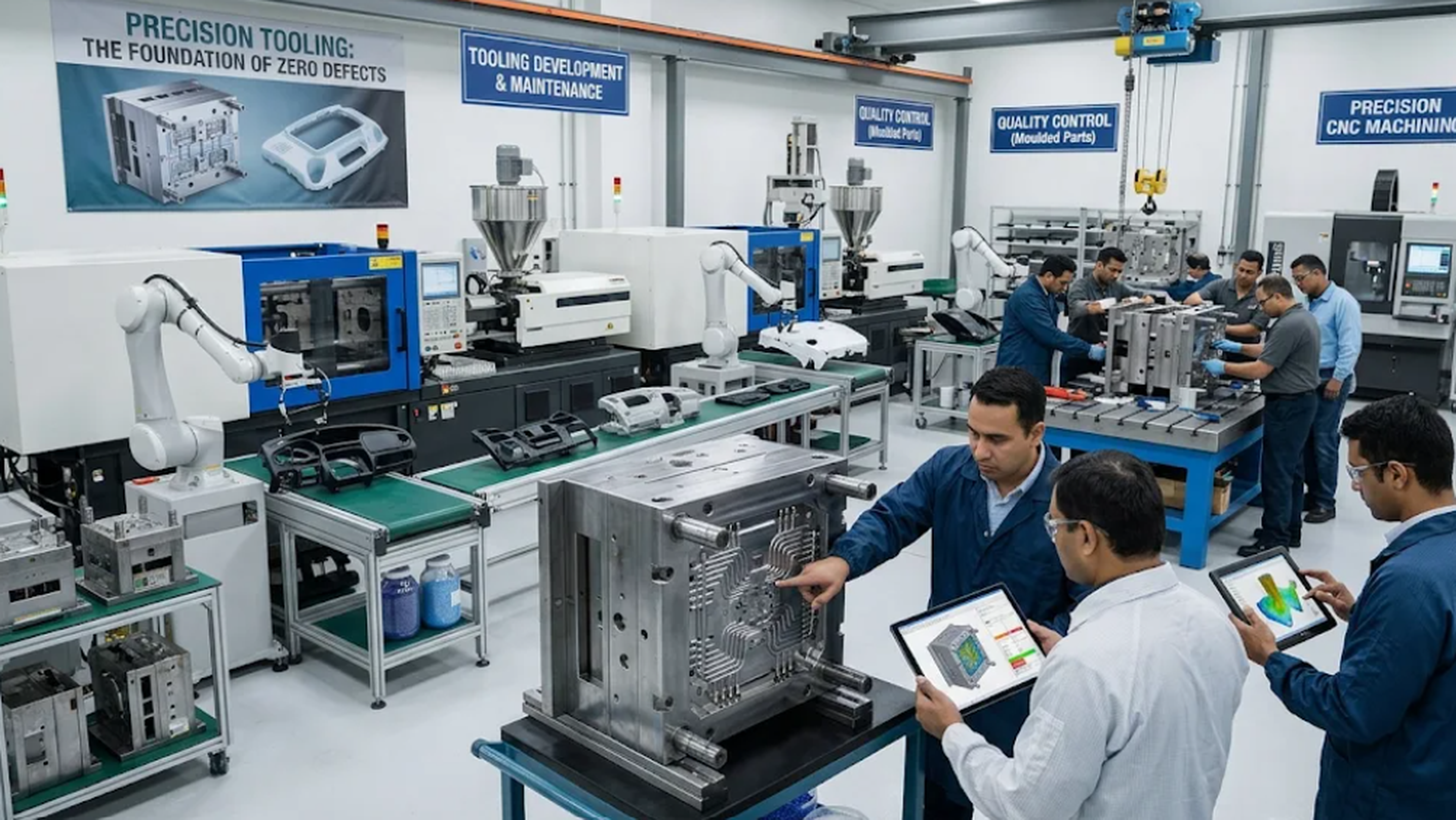

Published on 10th November 2026
A consumer electronics company had completed pilot production of a new device and was preparing to commit to mass production. The pilot units had performed well in functional testing. The internal engineering team was confident the design was ready to scale. A contract manufacturer had been selected for the volume build, and the production timeline was set.
Before tooling was finalised and the BOM was locked, an EMS partner conducted a structured DFM and tooling review. The review was not a formality. It was a systematic comparison of the design's production assumptions against the realities of what an automated high-volume line would actually encounter.
What the review found changed the production plan.
During the DFM review, a mismatch was identified between the enclosure's mould design and the PCB's connector placement. The misalignment was not visible in the pilot units because at small batch volumes, the discrepancy had been absorbed by manual adjustment during assembly. Skilled assemblers making fine corrections during a hand-built pilot run do not generate the data that reveals a systemic design problem.
At mass production volumes, that manual correction disappears. An automated line cannot accommodate the same tolerance stack-up that a human assembler can adjust for by hand. The result would have been a measurable defect rate surfacing only after units had reached distribution, with no clear cause visible from the finished product.
This is one of the most common and most expensive failure modes in electronics manufacturing: a design that works perfectly at pilot scale, built by skilled technicians who compensate for dimensional variation without documenting it, and then fails at volume when the compensation is no longer available.
Because the issue was identified during the pre-production DFM review, the correction required was a targeted revision to the mould design and a minor repositioning of the connector on the PCB layout. Both changes were made before tooling was cut and before the BOM was finalised.
The timeline comparison is significant:
Stage of Discovery | Typical Cost and Consequence |
|---|---|
Pre-production DFM review | Mould revision and PCB layout change; short delay to production schedule |
After tooling is cut | Tool rebuild or significant rework; weeks of delay; cost absorbed by client or disputed with manufacturer |
After first production run | Rework of finished units; production line stoppage; potential BOM relock |
After distribution | Field failure; potential recall; warranty cost; reputational damage with retail and end-customer |
The correction added a short delay to the production timeline. It avoided a field failure, a potential recall, and the reputational and financial cost that a quality escape at distribution scale would have carried.
The core lesson from this engagement is not specific to the mould-connector misalignment. It is about the structural gap between pilot production and mass production readiness.
Pilot builds are typically assembled by experienced technicians, often in conditions that are more controlled and more manually intensive than a production line. They generate functional test data, but they do not generate the data that reveals process scalability issues, tolerance stack-up problems at volume, or assembly steps that rely on manual adjustment rather than designed-in fit.
A structured DFM review conducted by a manufacturing partner with direct experience of high-volume line conditions can surface the gap between what the design assumes and what the production process will actually deliver. That review is only useful if it happens before tooling is committed and before the BOM is locked. After those decisions are made, the cost of correction increases sharply at every subsequent stage.
"This is a groundbreaking device, and I want everyone to understand how important Flexi Versa Group has been in its birth and delivery. The work done here will be so important to so many people around the world."
Enterprise client, medical device programme
FVG's approach to New Product Introduction (NPI) is structured around the principle that manufacturing risk is cheapest to address at the earliest possible stage. The DFM and tooling review described in this case study is part of a broader NPI process that includes:
DFM and DFT reviews conducted before tooling or line setup begins
BOM analysis and component risk assessment, including alternate part qualification for components with availability or EOL risk
Pilot builds under production-representative conditions, not engineering sample conditions, so yield and scalability issues surface before volume commitments are made
Test strategy development aligned to the specific product and regulatory requirements of the programme
For OEMs preparing to scale a product, this structured NPI support is often the difference between a controlled ramp to mass production and a costly rework cycle that surfaces after delivery commitments have already been made to customers.
Three sectors. Three distinct types of risk. Three different scales of operational pressure. The pattern that connects them is not a single capability or service offering. It is an approach to manufacturing partnership that shows up consistently across programme types.
In each case, the value FVG delivered was not reactive. In Case Study 1, the supply chain control tower was deployed before the disruption escalated further, not after production had stopped. In Case Study 2, the material formulation and process validation were developed from the outset to meet regulatory requirements, not retrofitted after a compliance gap was identified. In Case Study 3, the DFM review happened before tooling was committed, when the cost of correction was still manageable.
The common factor is timing. Manufacturing problems that are identified before they become production failures cost a fraction of what they cost after the fact. An EMS partner whose engineering capability is limited to executing a defined scope cannot provide this kind of upstream value. The capability has to exist, and it has to be applied proactively.
None of the three engagements was bounded strictly by the original statement of work. In the supply chain case, FVG built data infrastructure and operational processes that transferred to the client's own team and continued to deliver value after the immediate crisis was resolved. In the medical device case, FVG took a product from material formulation through regulatory registration, a scope that goes well beyond standard EMS contract manufacturing. In the NPI case, the DFM review identified a risk in the mould design that fell outside the assembly contract but was surfaced and addressed anyway.
This is the distinction between a vendor relationship and a partnership. A vendor performs the contracted scope. A partner takes accountability for the outcome.
The testimonials collected from FVG's client base reinforce this consistently:
"Selecting FVG as a new EMS player to partner us in our medical electronics was driven by their complete solutions, including their customer-centric focus, strong quality mindset, and competitive offerings."
Enterprise client, regulated manufacturing sector
"The team at Flexi Versa guided and supported us throughout our visit, ensuring every task was completed smoothly. Everyone we met was knowledgeable, professional, and represented the company exceptionally well. Their focus, organisation, and responsiveness made the experience both productive and welcoming, leaving us with full confidence in their capabilities."
Enterprise client, following site visit
These assessments describe the same quality of engagement: engineers who work alongside the client's team, communication that keeps decision-making in the client's hands, and a level of accountability that extends to outcomes rather than stopping at task completion.
That quality of engagement is what enterprise procurement teams and engineering leads are evaluating when they assess an EMS partner. Certifications and facility specifications are necessary conditions for consideration. They are not sufficient conditions for confidence. The evidence that matters is operational: what happened when something went wrong, how it was managed, and whether the client's own position was protected throughout.
The three cases in this article provide that evidence across three different sectors and three different categories of manufacturing risk.
FVG is a vertically integrated EMS provider serving multinational OEMs across medical devices, semiconductor equipment, industrial automation, and consumer electronics. Capabilities span precision injection moulding and silicone processing, PCBA and SMT assembly, full box build integration, supply chain management, and testing and validation.
FVG holds ISO 13485:2016 certification for medical device quality management, alongside ISO 9001, IATF 16949, ISO 14001, and ISO 27001. Cleanroom manufacturing capabilities include NEBB-certified ISO 14644 Class 7 and Class 8 environments. Manufacturing sites operate across Southeast Asia and North America.
For OEMs evaluating a contract manufacturing partner, the starting point is a direct conversation with FVG's engineering team about your specific programme requirements.
Contact FVG: [email protected] | flexiversa.com
When a global electronics manufacturer approached FVG, their production lines were being halted by chip stockouts on a near-weekly basis. Emergency air freight had become a routine cost rather than an exceptional one. And across their supply network, the data was fragmented: no single view of what was at risk, which lines were most exposed, or where the next disruption was likely to materialise.
This is a case study in how FVG deployed a structured supply chain control tower to shift that organisation from reactive crisis management to proactive risk control, within four weeks, without requiring new system investment from the client.