news
E-Waste Collection Programme 2026: Building a Traceable Process at FCSB and VMSB
/)

Published on 15th October 2026
Flexi Versa Group | Flexi Component Sdn. Bhd. (FCSB) and Versa Manufacturing Sdn. Bhd. (VMSB)
The world generated a record 62 million tonnes of e-waste in 2022, up 82% from 2010, and is on track to reach 82 million tonnes by 2030. Only 22.3% of that mass was documented as properly collected and recycled.
The gap is not only a national-infrastructure problem.
A large share of e-waste never enters a formal system because it starts in drawers, desks and storerooms: old chargers, tangled cables, dead phones, broken extension leads. Small items are easy to postpone and easy to bin.
The core problem: when e-waste reaches a general bin, the metals, batteries and circuit boards inside it are lost to recovery and become a contamination risk.
Flexi Versa Group (FVG) operates manufacturing sites in Johor Bahru through Flexi Component Sdn. Bhd. (FCSB) and Versa Manufacturing Sdn. Bhd. (VMSB) sets out how FVG's Environmental, Health and Safety (EHS) team gave employees a controlled, documented route for their e-waste, and what the first programme delivered.
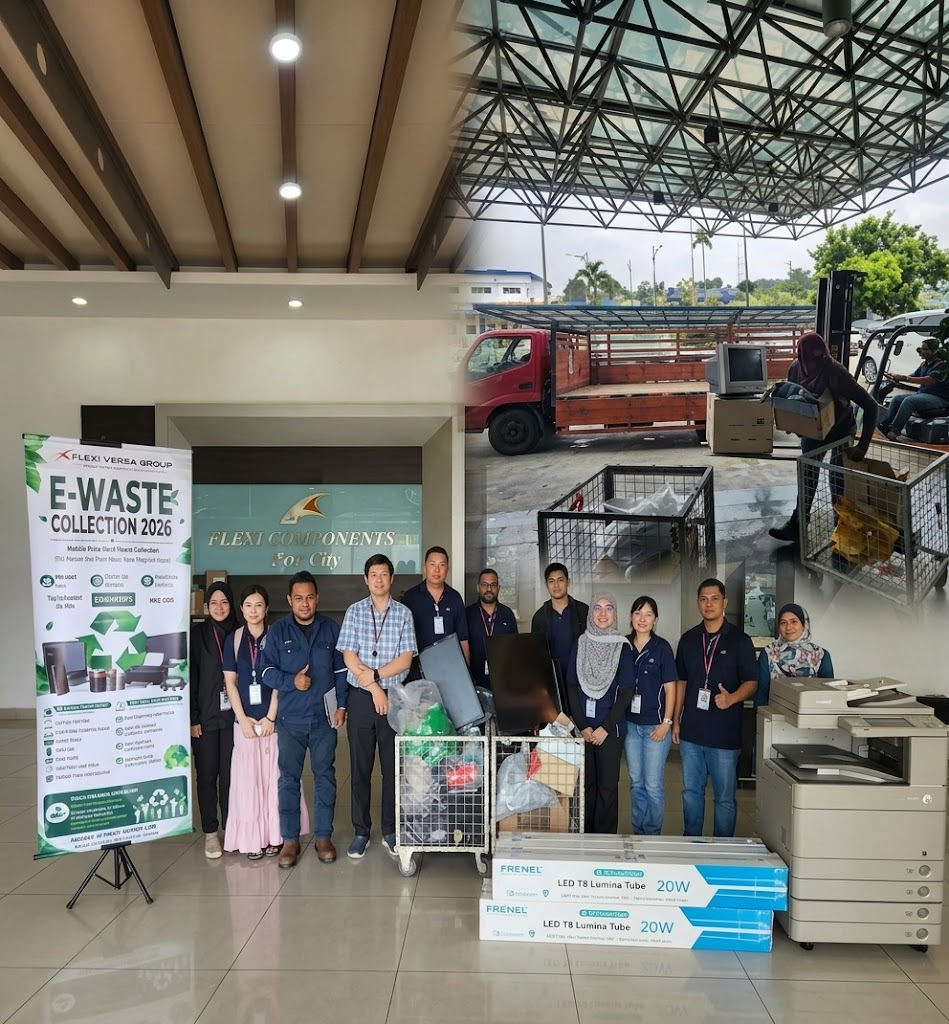
From 1 to 23 September 2026, FCSB and VMSB ran an E-Waste Collection Programme across both sites. EHS set up clearly marked drop-off points at the main lobby of each site and circulated awareness materials explaining what to bring and what must stay out of the general waste bin.
Computers and office electronics. Old computers, monitors and related equipment.
Power accessories. Chargers, adapters, cables and extension leads.
Electronic components. Circuit boards and small electronic parts.
Small appliances. Obsolete or damaged small electrical appliances.
Every item was inspected by EHS for damage or leakage, sorted by category, and held in a labelled, controlled area until collection. Nothing moved from a lobby drop-off point to disposal without a record.
On 2 October 2026, the collected e-waste was handed over to a licensed recovery facility.
Measure | Result |
|---|---|
Total e-waste collected | 60 kg (FCSB: 20 kg, VMSB: 40 kg) |
Recovered through approved, licensed routes | 100% |
Uncontrolled disposal incidents | Zero |
Transfers documented | 100%, with a Certificate of Destruction issued for each site |
Operational reality: Sixty kilograms is a modest tonnage. The value of the first campaign lies in the 100% documented chain of custody, which is the foundation any larger volume will depend on.
In Malaysia, e-waste is classified as scheduled waste (code SW110) under the Environmental Quality (Scheduled Wastes) Regulations 2005. It must be managed responsibly from storage through to transfer to a licensed facility.
For FVG, compliance was the starting point rather than the goal. The programme was designed around three controls:
Safe segregation. Items are inspected and sorted by category on receipt.
Clear records. Every transfer is documented, with a Certificate of Destruction per site.
Full traceability. Each kilogram is accounted for from drop-off to licensed recovery.
FVG thanks its EHS team, in particular Zailan and Rafiqah, for planning and running the programme, and every FCSB and VMSB employee who brought in e-waste. Participation at both sites is what made the results possible.
The 2026 programme is the baseline for a permanent system. FVG's plans for 2027 include:
Permanent collection points. A standing e-waste drop-off at each site.
Regular tracking. Monthly or quarterly e-waste monitoring, not campaign-only.
Measurable target. A recovery target set within the Group's environmental objectives.
The question is not whether e-waste is being generated in every workplace. It is. The question is whether the organisation has a segregated, documented and licensed route for it.
To learn more about FVG's approach to environmental responsibility, contact the FVG team .