case studies
Engineering-Driven PTH Soldering: Design Parameters That Define Reliability
/)

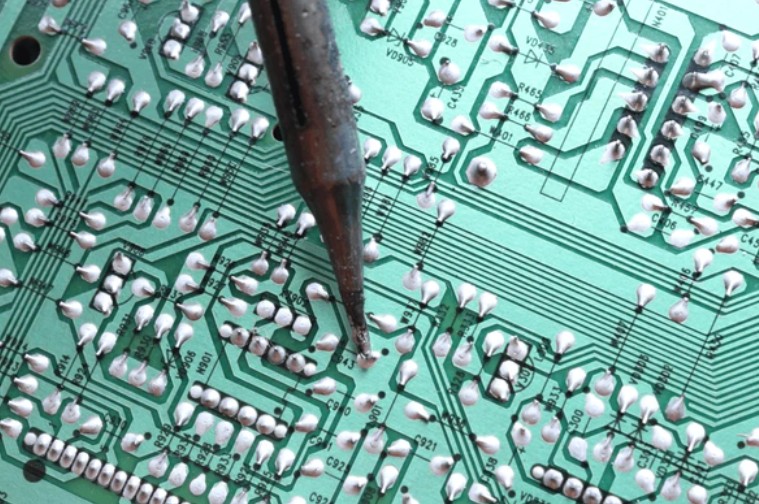
In high-reliability electronics manufacturing, Plated Through-Hole (PTH) soldering remains essential for connectors, high-current components, and mechanically stressed assemblies. While equipment capability is important, true process stability is determined by design parameters, thermal balance, and controlled solder dynamics.
At Flexi Versa Group (FVG), PTH soldering across Wave, Selective, Dip, and Robotic platforms is executed using design-for-soldering principles that optimize electro-migration control, hole filling performance, bridging mitigation, and thermal reliability.
Controlling Electro-Migration Through Flux Management
Selective and dip soldering processes demand strict control over flux deposition and spreading behavior. Excessive flux migration into non-heated areas can increase electro-migration risk and compromise long-term reliability.
To mitigate this, the following parameters are maintained:
Low surface energy solder mask (~35 mN/m²) for improved flux confinement
Defined flux application zones within nozzle boundaries
Controlled dropjet flux volume to eliminate satellite formation
Adequate spacing from adjacent SMT components
By engineering the solder mask and flux interaction at the design stage, contamination risk and solder balling are significantly reduced.
Optimizing Through-Hole Barrel Design and Hole Filling
Reliable barrel fill depends on the balance of:
Heat transfer efficiency
Dwell time (contact duration)
Thermal mass of pin and copper layers
Pin-to-hole clearance

Recommended Design Parameter:
Hole diameter = Pin diameter + 0.4 mm
This ratio ensures sufficient solder wetting without excessive void formation. When pins are not centered relative to the solder nozzle, contact time can decrease by approximately 15%, directly impacting fill quality. Immersion depth and drag speed must therefore be precisely programmed.
For multilayer PCBs, additional considerations include:
Thermal relief design to reduce copper heat sinking
Controlled copper layer distribution around barrels
Preheat profiling to stabilize top-side temperatures
Limiting heavy copper connections to barrels improves solder penetration consistency and prevents cold joints.
Pad Geometry and Bridging Prevention
Bridging defects are strongly influenced by pad diameter and lead protrusion length. Process studies indicate that pad geometry has a greater effect on bridging than flux speed or board temperature.
Design Guidelines:
Minimize pad diameter on the solder side
Reduce excess lead protrusion
Avoid solder thieves in lead-free processes
Introduce silkscreen barrier lines to interrupt capillary flow
These adjustments significantly reduce bridging without increasing process complexity.
Thermal Balance and Pad Integrity
Thermal mismatch between copper barrels, solder alloy, and PCB substrate can result in fillet lifting or pad lifting. Managing thermal exposure is critical.
Typical process parameters include:
Solder temperature approximately 300°C (depending on mass)
Dwell time between 5–10 seconds for sensitive assemblies
Smaller solder-side pads to reduce thermal stress
Thermal relief patterns to localize heat
Notably, 300°C for 7 seconds can create a similar thermal impact as 310°C for 5 seconds, demonstrating the importance of balancing temperature and exposure duration.

Nozzle Selection and Clearance Requirements
Selective soldering performance is closely tied to nozzle diameter and board clearance.
Recommended parameters:
Minimum 0.5–1.0 mm clearance from adjacent SMT components
Larger nozzles (>6 mm) for improved thermal stability
Smaller nozzles (~4 mm minimum) requiring higher solder temperatures
Board warpage compensation may be applied to maintain consistent immersion depth. Connector mass must also be evaluated, as thicker pins demand increased thermal energy and optimized nozzle selection.
Managing Re-Melting Risk in Dense Assemblies
In mixed SMT and PTH assemblies, re-melting of nearby solder paste must be prevented. Controlled dwell time, appropriate spacing, and directional drag orientation ensure stable joints even at elevated solder temperatures.
Thermal measurement validation confirms that, under controlled parameters, re-melting does not occur despite high solder bath temperatures.
Integrated PTH Platform Strategy
Flexi Versa Group applies these engineering parameters across all PTH soldering solutions:
Wave Soldering for high-volume standardized production
Selective Soldering for complex SMT + PTH boards
Dip Soldering for multi-pin connectors
Robotic Soldering for precision, high-reliability applications
By aligning design, thermal profiling, flux control, and mechanical geometry, FVG ensures IPC-compliant solder joints with high first-pass yield and minimal rework — critical for automotive, industrial, and medical electronics.
Conclusion
High-quality PTH soldering is determined not solely by process selection but by disciplined control of design parameters, thermal energy, and solder dynamics.
Through structured DFM engagement and parameter-driven manufacturing control, Flexi Versa Group delivers reliable, scalable PTH soldering solutions engineered for long-term performance in demanding applications.