resources
How FVG's Manufacturing Automation Technologies Reduce Operational Overhead and Protect Long-Term Margin Stability

Published on 16th November 2026
Margin pressure in electronics manufacturing rarely arrives as a single event. It accumulates quietly: a rework loop that adds two hours to a work order, a process parameter that drifts between shifts, a manual inspection step that catches defects downstream rather than at source. In a high-mix, low-to-medium volume environment, where programmes switch frequently and lot sizes are small, these inefficiencies compound faster than they do on a high-volume commodity line.
The conventional response is to absorb the cost, adjust the quote on the next renewal, or accept that high-mix manufacturing carries an inherent overhead premium. FVG's position is that this framing is wrong. Over more than 30 years of engineering and manufacturing operations across Southeast Asia and North America, the company has built a set of automation technologies and process control disciplines that treat overhead reduction not as a periodic cost-saving exercise but as a structural engineering objective built into every production line.
This article explains how those technologies work across FVG's core manufacturing disciplines, why they matter specifically in a high-mix context, and what the operational consequences are for OEM clients in terms of predictable unit economics and long-term margin stability.
High-mix manufacturing is structurally different from high-volume production in ways that most cost models underestimate. A factory building a single product at scale can optimise every parameter for that product and run it indefinitely. A factory managing dozens of active programmes, each with different PCB layouts, component sets, moulded enclosures, and test sequences, faces a fundamentally different challenge: every changeover is a potential source of error, and every manual intervention is a potential source of cost.
The overhead categories that erode margin in high-mix EMS tend to cluster around three areas:
Process variability: Parameters that are manually set, operator-dependent, or undocumented drift between production runs. A solder paste volume that was correct on Monday may be out of tolerance by Thursday if the stencil cleaning interval is not precisely controlled.
Defect escape and rework: Defects caught late in the production sequence, at functional test or during final inspection, carry a significantly higher remediation cost than defects caught at the process step where they originate. A solder bridge detected at in-circuit test requires board-level rework; the same bridge caught inline by automated optical inspection (AOI) immediately after reflow requires only a targeted touch-up.
Changeover and setup time: In low-to-medium volume programmes, setup time as a proportion of total production time is much higher than in high-volume work. Manual changeover procedures, unvalidated parameter recipes, and undocumented first-article approval processes all extend setup windows and reduce effective machine utilisation.
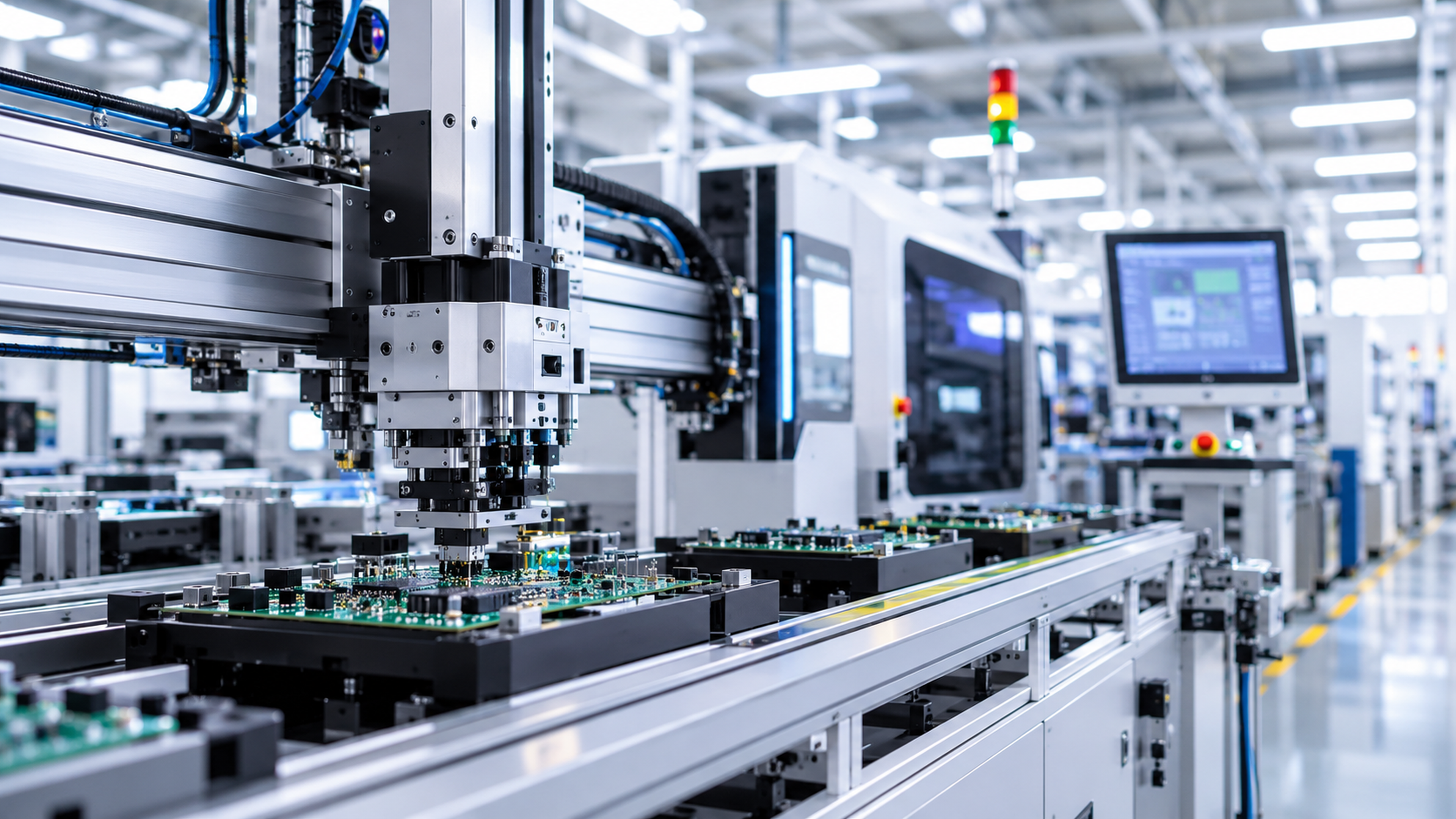
Surface mount technology assembly is the process step where the majority of PCBA defects originate, and where automated process control delivers the most measurable impact on yield and cost. FVG's SMT and PCBA operations integrate automated inspection and closed-loop process feedback at every stage of the reflow sequence, rather than relying on end-of-line inspection to catch what the process missed.
The first automated checkpoint is solder paste inspection, conducted immediately after the stencil printing stage. FVG's inline SPI systems measure paste volume, area, height, and offset for every pad on every board before a single component is placed. This matters because solder paste volume is the primary predictor of downstream defect categories including solder bridges, insufficient joints, and tombstoning.
Critically, the SPI data feeds back into the printing process in real time. If paste volume drifts outside the control limits for a given pad geometry, the system flags the condition before placement begins. This approach prevents an entire lot from proceeding through pick-and-place and reflow with a known paste defect, which is the failure mode that creates the most expensive rework scenarios.
After reflow, every board passes through automated optical inspection before it progresses to functional test. FVG's AOI systems are programmed to the specific component library and placement tolerances of each individual programme, which means inspection coverage is not generic but calibrated to the actual failure modes relevant to that board design.
The operational consequence is a significant reduction in defect escape rate to functional test. Defects caught at AOI are remediated at the board level with a targeted rework operation. Defects that escape to functional test require fault isolation, which adds diagnostic time, skilled technician involvement, and, in some cases, component-level disassembly.
For assemblies with ball grid array (BGA) components, fine-pitch QFN packages, or other configurations where the solder joint is not optically accessible, FVG deploys automated X-ray inspection. This capability is particularly relevant for programmes in the semiconductor equipment and medical device sectors, where a voided BGA joint that passes visual inspection can cause intermittent field failures under thermal cycling.
Across all SMT equipment, FVG maintains validated, locked parameter recipes for each active programme. Reflow profile, stencil aperture ratio, squeegee pressure, and paste deposit specifications are documented and version-controlled. When a programme re-enters production after a period of inactivity, the line is set up from the validated recipe rather than from operator recollection or a generic baseline. This eliminates one of the most common sources of run-to-run variability in high-mix environments.
Operational impact: Programme-specific parameter recipes, combined with inline SPI and AOI, mean that the first board off the line in a re-run programme carries the same process confidence as the hundredth board in a continuous production run. That consistency is what makes unit cost predictable across the life of a programme.
Injection moulding is a process where the relationship between input parameters and output quality is non-linear and highly interactive. Melt temperature, mould temperature, injection pressure, holding pressure, cooling time, and gate geometry all influence part dimensions, surface quality, and structural integrity simultaneously. A change in one variable can shift the effect of another in ways that are not immediately apparent from visual inspection alone.
This complexity is what makes manual parameter management in moulding operations a persistent source of overhead. When operators adjust settings based on experience rather than validated recipes, the result is part-to-part variation that may not manifest as an obvious defect but will accumulate as dimensional drift, fitment issues during assembly, or field failures under load.
FVG's moulding operations run on validated, programme-specific parameter sets that are locked at the machine controller level. Mould-temperature controllers maintain cavity and core temperatures within tight tolerances throughout the production run, compensating for ambient temperature variation and thermal load changes as the mould cycles. This is particularly important in precision applications, including medical device enclosures and semiconductor handling components, where dimensional tolerances are specified in tenths of a millimetre and shrinkage variation is not acceptable.
The practical consequence is that a mould tool re-entering production after a tooling maintenance interval produces first-off parts that conform to specification without an extended warm-up and adjustment period. That reduction in non-productive machine time directly reduces the overhead cost per production order.
Manual part removal from mould tools introduces variability in cycle time and, in precision applications, the risk of part damage during handling. FVG integrates robotic part-removal cells on precision moulding lines, ensuring consistent cycle times and eliminating handling-induced cosmetic or dimensional defects. Automated degating, where the gate vestige is removed mechanically rather than manually, produces a consistent gate finish without the operator-to-operator variation that manual trimming introduces.
For programmes supplying components into box build and system integration assemblies, consistent enclosure dimensions and gate finishes directly affect downstream fit and assembly time. A moulded enclosure that varies in gate vestige height by 0.3 mm may cause fitment interference during final assembly, adding a manual correction step that was not in the original work order.
Critical moulded components in FVG's medical and semiconductor programmes are subject to inline dimensional verification using automated gauging systems. Rather than sampling finished parts at the end of a production run, dimensional data is collected at defined intervals during the run, allowing process drift to be identified and corrected before it produces a non-conforming batch.
This approach aligns with the process validation requirements of ISO 13485:2016 for medical device manufacturing, where process monitoring during production is an explicit requirement rather than a post-hoc quality check. It also means that the dimensional data record for each production order is available for customer review, supporting traceability requirements without additional inspection effort.
Parameter Category | Manual Approach Risk | FVG Automated Control |
|---|---|---|
Mould temperature | Drift between cycles, shift-to-shift variation | Closed-loop mould-temperature controllers |
Injection and holding pressure | Operator-adjusted, undocumented changes | Locked validated recipe at machine controller |
Cycle time | Variable with manual part removal | Robotic extraction, consistent cycle |
Dimensional verification | End-of-run batch sampling | Inline gauging at defined intervals |
Gate finish | Manual trim, operator-dependent | Automated degating, consistent vestige |
Individual automation investments in SMT or moulding deliver process-level benefits. The more significant margin protection, however, comes from the way FVG's vertical integration allows those automation disciplines to compound across the full manufacturing sequence.
In a fragmented supply chain, where a moulded enclosure is produced by one supplier and the PCBA by another, the interface between those two scopes is a quality gap. Dimensional data from the moulding operation is not visible to the electronics assembly team. A fitment issue that emerges during box build is diagnosed from scratch, without access to the process history of either sub-assembly. The cost of that diagnostic gap, in engineering time, schedule delay, and potential scrap, sits entirely with the OEM or the box build integrator.
FVG's high-mix, low-volume manufacturing model eliminates that interface by holding moulding, SMT assembly, and box build integration under a single operational roof. The practical consequences are measurable:
Cross-process data visibility: Process data from moulding and SMT operations is accessible to the box build team before integration begins. Dimensional records from moulded enclosures are reviewed against PCBA stack-up tolerances before assembly, rather than after a fitment failure.
Closed-loop engineering feedback: When a box build integration step reveals a dimensional or clearance issue, the engineering team can trace it to the originating process step and adjust the validated recipe. That feedback loop does not exist when moulding and electronics are split across separate suppliers.
Single quality record: Traceability from raw material through to finished system is maintained within a single quality management system, which significantly reduces the documentation burden for customers in regulated industries.
FVG's manufacturing operations are supported by ERP integration that connects production scheduling, material consumption, and process data capture across all manufacturing disciplines. Work orders are linked to validated parameter recipes, component traceability records, and inspection results. This means that the production history of any unit, from the batch of resin used in its moulded enclosure to the reflow profile applied to its PCBA, is retrievable from a single system record.
For customers in the medical device and semiconductor sectors, this level of data integration is not a differentiator; it is a baseline requirement. What makes it relevant to the margin discussion is that capturing this data through automated means, rather than manual entry, eliminates the overhead of dedicated data-entry resources and removes the transcription errors that create audit findings.
The integration advantage: When moulding, SMT, and box build share a common process data infrastructure, the cost of quality assurance across the programme falls. There is no duplication of inspection effort at supplier interfaces, no re-qualification when a sub-assembly moves from one facility to another, and no diagnostic delay when a quality event needs to be traced to its root cause.
Process automation on the production floor protects margin from internal variability. Supply chain automation addresses the external variability that can make internal process control irrelevant: a line-down event caused by a component shortage, a sole-source risk that was never identified, or a material substitution that was not properly qualified before it entered production.
FVG's supply chain and lifecycle management capabilities are built on API-integrated ERP systems that provide real-time visibility into component inventory levels, supplier lead times, and programme demand schedules. This integration allows the supply chain team to identify coverage gaps and alternate sourcing requirements before they become production constraints, rather than responding to a shortage after the line has stopped.
One of the highest-overhead activities in EMS supply chain management is emergency alternate material qualification: identifying a substitute component when the primary source is unavailable, evaluating its technical equivalence, getting customer approval, and validating it in the production process. When this happens reactively, under schedule pressure, it consumes engineering resources disproportionate to the cost of the component itself.
FVG's approach is to qualify alternates proactively, during the NPI and engineering phase, before the programme enters volume production. Approved alternate part lists (APLs) are built into the programme documentation so that when a primary component becomes constrained, the supply chain team can switch to a qualified alternate without initiating a new engineering evaluation. The lead time for that response is measured in days rather than weeks.
FVG's procurement network spans Southeast Asia and North America, which provides geographic diversification against the regional supply disruptions that have characterised the electronics component market since 2020. Automated demand forecasting, integrated with customer programme schedules, drives inventory positioning decisions that balance carrying cost against the risk of a production stoppage.
For customers running high-mix programmes with multiple active SKUs, this forecasting capability is particularly valuable. The cost of a line-down event on a low-volume programme, where the fixed overhead of the production order is spread across a small quantity of units, can eliminate the margin on an entire quarter's production in a single incident.
The supply chain margin argument: Unplanned production stoppages are among the most damaging margin events in EMS, not because of the direct cost of the stoppage itself, but because of the expedite fees, premium freight, and customer penalty clauses that follow. Automated supply chain visibility and proactive alternate qualification are the mechanisms that prevent those events from occurring.
FVG's commitment to solar-powered manufacturing operations is often discussed in the context of environmental responsibility. Its relevance to margin stability is less frequently examined, but it is direct.
Energy cost is a significant and growing component of manufacturing overhead in Southeast Asia. As electricity tariffs in Malaysia respond to broader energy market pressures, manufacturers that rely entirely on grid power face an overhead line item that is outside their operational control. FVG's solar energy infrastructure provides a degree of insulation from that variability by reducing grid dependency during production hours.
The connection to automation is structural. Automated production lines, with consistent cycle times and predictable machine utilisation profiles, are better suited to solar-optimised energy management than manual operations with variable throughput. The same process discipline that makes FVG's automated lines predictable from a quality standpoint makes them predictable from an energy consumption standpoint, which is a prerequisite for effective solar integration.
This is not a marginal consideration. For OEM clients with sustainability reporting obligations, manufacturing at a solar-powered facility contributes directly to Scope 3 emissions reduction targets. As supply chain sustainability requirements from end customers and regulators become more stringent, the ability to demonstrate low-carbon manufacturing is increasingly a commercial requirement rather than an optional attribute.
The operational value of FVG's automation investments is not abstract. For an OEM running a high-mix programme in medical devices, semiconductor equipment, or industrial automation, the practical consequences translate into three commercial outcomes:
Predictable unit economics across the programme lifecycle. Validated parameter recipes, inline inspection, and automated process control mean that the cost of producing a unit in month 18 of a programme is not materially different from the cost in month 3. There is no gradual margin erosion driven by process drift, accumulated rework, or operator turnover.
Reduced quality event frequency and severity. Defects caught at source, before they propagate through the production sequence, cost a fraction of defects caught at functional test, during customer incoming inspection, or in the field. The reduction in quality event frequency also reduces the engineering overhead associated with corrective action, root cause analysis, and customer communication.
Supply chain resilience without premium pricing. Proactive alternate qualification and automated supply chain visibility mean that component constraints are managed as a routine operational matter rather than a crisis. The cost of that resilience is built into FVG's programme infrastructure rather than passed to the customer as a premium line item.
The Malaysia manufacturing environment supports this model. With approved manufacturing investments reaching RM131.3 billion in 2025, Malaysia's industrial ecosystem is actively expanding automation capability, which means the supplier and tooling infrastructure that supports FVG's automation investments is deepening rather than thinning.
For OEM procurement and engineering teams evaluating EMS partners, the question worth asking is not whether a partner has automation capability, but whether that capability is integrated across the full manufacturing sequence in a way that protects programme economics over time. That integration is what FVG has built, and it is what makes the difference between an EMS partner that quotes competitively and one that delivers predictably.
To discuss how FVG's manufacturing automation capabilities apply to your specific programme, contact the FVG team.