resources
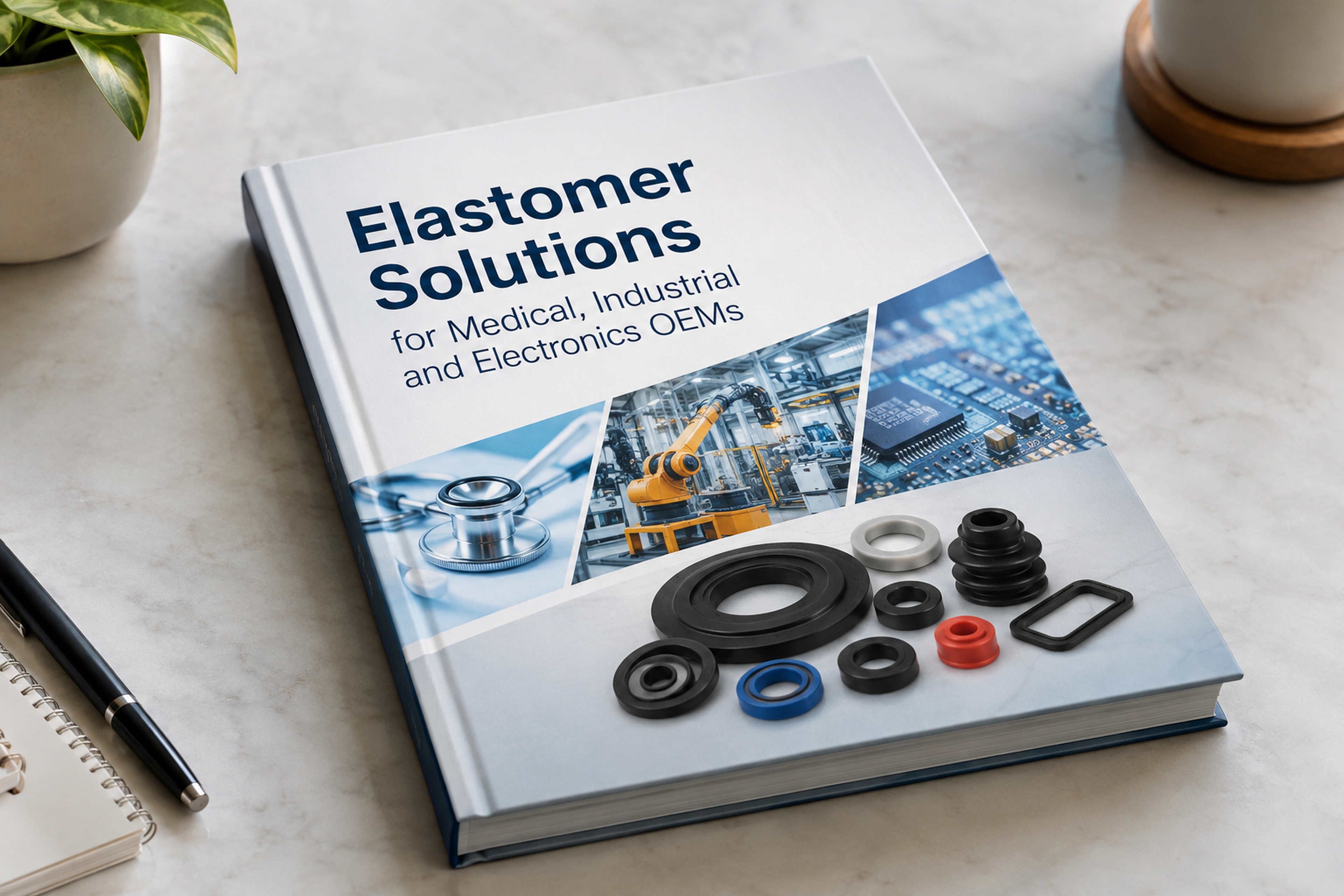
Elastomer Solutions for Medical, Industrial and Electronics OEMs


Published on 26th October 2026
Elastomers sit at the intersection of material science and precision engineering. In medical devices, they form the fluid paths, seals, and body-contact surfaces that determine both clinical performance and regulatory compliance. In industrial equipment, they absorb vibration, resist aggressive chemicals, and maintain integrity across wide temperature ranges. In electronics and wearables, they provide the flexible enclosures and environmental protection that rigid plastics cannot.
For OEM engineers, the challenge is rarely identifying that an elastomeric component is needed. The real complexity lies in selecting the right material from a broad family of compounds, choosing the appropriate moulding process for the geometry and volume, and ensuring the entire manufacturing chain meets the quality and traceability standards the application demands.
The global injection moulding solutions market reached $38.7 billion in 2025 and is projected to grow to $62.4 billion by 2034, according to market data from Dataintelo, with elastomers representing a 12.3% share concentrated in medical device grips, automotive sealing systems, and industrial vibration isolation. That growth reflects how central precision elastomeric components have become to product development across sectors.
Material selection is the first and most consequential decision in any elastomer project. The wrong compound can lead to premature seal failure, regulatory non-compliance, or incompatibility with the sterilisation or chemical exposure the component will face in service. The right compound, properly specified, delivers decades of reliable performance.
FVG works with a broad elastomer portfolio spanning standard-grade and high-performance compounds, enabling material matching to the precise thermal, chemical, and mechanical requirements of each application.
Material | Key Properties | Typical Applications |
|---|---|---|
NBR (Nitrile Butadiene Rubber) | Oil and fuel resistance, good mechanical strength | O-rings, seals, gaskets, hoses |
HNBR (Hydrogenated NBR) | Enhanced heat and chemical resistance vs. NBR | Automotive sealing, oil and gas, industrial belts |
EPDM (Ethylene Propylene Diene Monomer) | Excellent weather, ozone and heat resistance | Outdoor seals, electrical insulation, automotive belts |
CR (Chloroprene Rubber) | Balanced weathering, oil and flame resistance | Protective equipment, industrial rollers, cable jackets |
NR (Natural Rubber) | High elasticity, resilience, cost efficiency | Vibration mounts, industrial diaphragms, pharmaceutical closures |
For a detailed technical profile of specific compounds, FVG's material articles on HNBR, FKM, and natural rubber provide application-specific guidance.
When operating environments become more demanding, standard compounds reach their limits. FVG's high-performance range addresses extreme temperature, chemical exposure, and biocompatibility requirements:
VMQ (Vinyl Methyl Silicone): Wide temperature range, biocompatible, suitable for food-contact and medical applications
FVMQ (Fluorosilicone): Combines silicone's temperature stability with improved fuel and solvent resistance
FKM (Fluorocarbon Rubber / Viton): Outstanding resistance to fuels, oils, acids, and temperatures up to 200°C; widely used in aerospace and chemical processing
FFKM (Perfluoroelastomer): The highest-performance elastomer available; near-universal chemical resistance and temperature capability to 327°C; used in semiconductor processing and critical pharmaceutical sealing
Selecting between FKM and FFKM is not purely a performance decision; it is a cost-risk decision. FFKM carries a significant price premium. For most industrial sealing applications, FKM delivers sufficient performance. FFKM is justified where chemical exposure or temperature would degrade FKM over the component's service life, making replacement or failure unacceptable.
Material selection and process selection are interdependent. The geometry, volume, tolerance requirements, and material viscosity of a component will determine which moulding process is appropriate. Using the wrong process for a given material-geometry combination leads to dimensional inconsistency, surface defects, or excessive cycle times that erode cost competitiveness.
FVG operates a range of elastomer manufacturing processes, allowing the appropriate method to be matched to each application rather than forcing components into a single process.
Liquid Silicone Rubber (LSR) injection moulding is the primary process for high-precision, high-repeatability silicone components. The process injects a two-part platinum-catalysed liquid silicone compound into a heated mould cavity, where it cures to a stable, flexible solid. FVG's LSR injection moulding capability achieves tolerances of 0.08 to 0.15 mm, supporting complex geometries that would be impractical with compression moulding.
Key advantages of LSR injection moulding include:
High repeatability across large production runs
Ability to mould thin walls and fine features
Compatibility with cleanroom manufacturing environments
Reduced post-processing requirements due to flash-free tooling
Compression moulding remains the preferred process for large-cross-section parts, low-volume production, and materials that are difficult to inject. A pre-formed compound is placed in an open mould cavity, which is then closed under heat and pressure until the material cures. Transfer moulding offers a middle ground, with better dimensional control than compression moulding and lower tooling cost than injection moulding.
For continuous profiles, tubing, and cable jacketing, extrusion is the appropriate process. FVG supports dual-material extrusion, enabling co-extruded profiles where two elastomers with different properties are combined in a single cross-section. Medical-grade silicone tubing, for example, requires tight wall-thickness tolerances and consistent inner diameter; FVG's engineering of medical-grade elastomer tubing addresses the process variables that cause dimensional drift during scale-up.
Co-moulding techniques extend the capability of single-material moulding by bonding elastomers to rigid substrates or other materials in a single production step.
Overmoulding deposits a silicone or elastomeric layer over a pre-formed substrate, such as a metal insert, a rigid thermoplastic housing, or a populated PCB. FVG has demonstrated overmoulding of silicone film as thin as 0.08 mm (±10%) onto nitinol wire mesh structures, a tolerance requirement that demands precise control of injection parameters and tooling temperature.
Insert moulding encapsulates a pre-placed insert within the elastomeric moulding, creating a mechanically integrated assembly without secondary bonding operations.
Both processes reduce assembly steps, eliminate adhesive layers that can degrade over time, and improve the dimensional stability of the final assembly. For IoT and wearable device manufacturers, FVG's silicone and elastomeric overmoulding capability covers the specific requirements of bonding flexible enclosures to electronic sub-assemblies.
Elastomeric components appear across a wide range of industries, but the performance requirements and compliance obligations differ significantly between sectors. Understanding those differences is what separates a generalist rubber moulder from a manufacturing partner capable of supporting regulated, mission-critical applications.
Medical applications impose the most demanding combination of material, process, and documentation requirements. Elastomeric components in this sector must demonstrate biocompatibility, withstand sterilisation cycles, and be manufactured under controlled conditions with full traceability.
FVG supports medical elastomer manufacturing across several component categories:
Biocompatible seals, gaskets, and catheter tips for diagnostic and therapeutic devices
Silicone overmoulding on sensors and electronics for wearable health monitors
Flexible enclosures and body-contact surfaces for implantable and skin-worn devices
Medical-grade silicone tubing for drug-delivery and fluid-path applications
Wound care products manufactured to Malaysia's Medical Device Authority (MDA) registration requirements
All medical elastomer manufacturing at FVG operates under ISO 13485-certified quality management, with cleanroom environments at Class 8 and Class 9 classifications, and validation procedures aligned with FDA 21 CFR 820 and IEC 60601 requirements. For OEMs managing regulatory submissions, the quality documentation framework is built into the manufacturing process rather than added retrospectively.
Industrial applications prioritise chemical resistance, thermal stability, and mechanical durability over long service intervals. Common requirements include:
O-rings, seals, and gaskets for hydraulic and pneumatic systems
Vibration isolation mounts and diaphragms for precision equipment
Chemical-resistant sealing for processing and fluid handling equipment
Electrical insulation and cable jacketing in high-temperature environments
Material selection for industrial applications typically centres on EPDM, HNBR, FKM, or NBR, depending on the specific chemical and thermal exposure profile. FVG's engineering team supports compound selection based on the actual service conditions rather than generic material datasheets.
Electronics applications require elastomers that can protect sensitive components from environmental ingress while remaining compatible with the thermal and mechanical constraints of electronic assembly.
IP-rated enclosures and gaskets for outdoor and industrial electronics
Antistatic and conductive rubber components for ESD-sensitive environments
Skin-safe silicone enclosures for smartwatches, fitness trackers, and biosensors
Flexible overmoulded housings for IoT devices combining PCBA and elastomeric protection in a single assembly
The integration of elastomeric moulding with FVG's in-house SMT and PCBA capability is a practical advantage for electronics OEMs. Rather than managing separate vendors for the electronics and the overmoulded enclosure, the entire sub-assembly can be developed, validated, and produced within a single facility. This reduces interface risk, simplifies quality oversight, and shortens the development cycle.
For regulated applications, the quality framework surrounding the manufacturing process carries as much weight as the process itself. A component manufactured outside a validated quality system cannot be used in a medical device, regardless of its dimensional accuracy or material properties.
FVG's elastomer manufacturing operates within a quality structure designed to support regulated industries from the outset:
Requirement | FVG Capability |
|---|---|
Quality management system | ISO 13485 certified |
Medical device regulation | FDA 21 CFR 820 aligned |
Electrical safety | IEC 60601 compliant processes |
Biocompatibility | ISO 10993 material qualification support |
Cleanroom classification | Class 8 (ISO 14644) and Class 9 |
Process validation | IQ/OQ/PQ documentation available |
Cleanroom manufacturing is not a checkbox; it is a process discipline. Contamination introduced during moulding, handling, or packaging can compromise biocompatibility test results and trigger regulatory non-conformances that delay product launch. FVG's Class 8 cleanroom environment maintains controlled particulate levels throughout the production and inspection stages for medical-grade components.
For semiconductor and pharmaceutical applications requiring FFKM sealing components, process validation documentation and material traceability records are produced as standard deliverables, supporting the customer's qualification activities.
The quality framework also extends to incoming material inspection, in-process dimensional verification, and final inspection against customer-defined acceptance criteria. Where customers require statistical process control data or capability indices as part of their supplier qualification, FVG's quality team can structure the reporting accordingly.
Elastomer development rarely begins with a finalised design. Most OEM programmes go through material trials, tooling iterations, and process optimisation before reaching production stability. A manufacturing partner that can only support full production runs is not useful during the development phase; one that can only support prototyping is not useful at scale.
FVG supports the full development-to-production continuum for both OEM (customer-specified design) and ODM (FVG-designed) elastomeric components:
Rapid prototyping and material trials: Early-stage samples to validate material selection and geometry before committing to production tooling
Tooling design and DFM review: Design for Manufacturability analysis to identify features that would cause dimensional variation, flash, or incomplete fill before tooling is cut
Pilot production: Controlled production runs for process validation and customer qualification activities
Volume production: Scalable production with in-process quality controls and documented traceability
This continuity matters particularly for medical device OEMs, where the manufacturing process validated during pilot production must be demonstrably equivalent to the process used in volume production. Switching manufacturers between development and production resets the validation clock and introduces risk into the regulatory submission.
FVG's vertically integrated model, which combines elastomer moulding with precision plastic injection moulding, SMT assembly, and box-build integration, also supports OEMs developing products that combine elastomeric and rigid components within a single assembly. For more on how integrated manufacturing reduces quality risk at the handoff between processes, see FVG's article on integrated medical device manufacturing for OEMs.
When qualifying an elastomer manufacturer, the technical capability of the moulding process is only part of the evaluation. The questions below reflect the decisions that most often determine whether a partnership delivers reliable production or generates recurring quality problems.
Does the manufacturer hold the relevant certifications, or are they working towards them? ISO 13485 certification for medical applications is not interchangeable with general quality management certification. Verify the scope of the certificate against the specific processes and product types it covers.
Can the manufacturer demonstrate process capability data, not just sample parts? A good sample lot does not confirm that a process is capable across production volumes. Ask for Cpk data on critical dimensions from a representative production run.
Is cleanroom manufacturing genuinely integrated into the production process, or is it a separate post-moulding step? Contamination introduced during moulding is not removed by a cleanroom packaging step. The moulding, inspection, and handling operations should all occur within the controlled environment.
How does the manufacturer handle material and process changes during the product lifecycle? In regulated industries, changes to materials, tooling, or processes require formal change control and may require revalidation. Understand the manufacturer's change notification and approval process before production begins.
What is the manufacturer's experience with your specific material family? FFKM processing, for example, requires tooling and process parameters that differ substantially from standard silicone. Experience with the specific compound matters more than general moulding capability.
These questions are not intended to create barriers; they are the practical engineering and quality considerations that determine whether an elastomer component will perform reliably in service and survive regulatory scrutiny.
FVG's elastomer capability is built around the requirements of OEMs operating in regulated and technically demanding industries. The material range, from standard NBR and EPDM through to FFKM, covers the full spectrum of sealing and component applications. The process range, from LSR injection and extrusion through to overmoulding and insert moulding, supports the geometry and volume requirements of development-stage programmes through to stable volume production.
What distinguishes FVG's approach is the combination of elastomer expertise with vertically integrated manufacturing. For OEMs developing products that combine elastomeric components with rigid plastic structures, PCBAs, or full box-build assemblies, FVG can hold the entire scope within a single facility, under a single quality management system, with a single point of accountability for the finished assembly.
The right starting point is a technical conversation about the application, not a quote request based on a drawing alone. Material selection, process choice, and tooling design are interdependent decisions that benefit from early engineering input. Engaging FVG at the design stage, rather than after the geometry is frozen, typically reduces the number of tooling iterations required and produces a more manufacturable component.
To discuss a specific elastomer requirement, contact FVG's engineering team through the elastomer and silicone solutions page.