resources
Value Analysis & Value Engineering (VAVE)
/)

Key takeaways:
Value Analysis & Value Engineering (VAVE) is a structured methodology that improves product value by balancing cost, quality, functionality, and manufacturability.
Value Engineering (VE) is applied during product design to optimise value before production, while Value Analysis (VA) focuses on improving products already in production.
VAVE helps organisations optimise product designs, manufacturing processes, material selection, and supply chain strategies without compromising performance.
Applying VAVE early can reduce unnecessary costs, improve manufacturability, strengthen supply chain resilience, and support continuous product improvement.
VAVE is widely used across industries to improve product quality, production efficiency, and long-term competitiveness.
Flexi Versa Group supports VAVE initiatives through integrated engineering, manufacturing, testing, and supply chain capabilities.
Improving product value involves more than reducing costs. Organisations must also consider quality, functionality, manufacturability, and long-term performance to remain competitive in today's market.
This is where Value Analysis & Value Engineering (VAVE) comes in. VAVE is a structured methodology used to identify opportunities to improve products and processes while maintaining or enhancing their intended function.
By evaluating design, materials, manufacturing methods, and sourcing strategies, organisations can optimise costs without compromising quality or reliability.
Whether developing a new product or improving an existing one, understanding VAVE can help organisations increase efficiency, improve product value, and support continuous improvement throughout the product lifecycle.
Value Analysis & Value Engineering (VAVE) is a systematic approach to improving product value by balancing cost, quality, functionality, and manufacturability.
Rather than focusing solely on reducing costs, VAVE evaluates every aspect of a product to identify opportunities for improvement while ensuring it continues to meet customer and business requirements.
Although the terms Value Analysis (VA) and Value Engineering (VE) are often used together, they are applied at different stages of the product lifecycle.
Value Analysis (VA) focuses on improving existing products, services, or processes after they have been introduced.
It involves reviewing functions, materials, manufacturing methods, and operating costs to identify opportunities to improve value. This may include reducing unnecessary costs, improving quality, simplifying production, or addressing component availability without affecting the product's intended performance.
Because VA is applied after a product has been developed, it supports continuous improvement throughout its lifecycle.
Value Engineering (VE) is applied during the design and development stage before production begins.
Its objective is to optimise product value early by evaluating design choices, material selection, manufacturing methods, and functionality. Identifying improvement opportunities during development helps reduce future production costs while maintaining quality and performance.
Applying VE early also helps minimise costly design changes later in the product lifecycle.
Although Value Analysis and Value Engineering are applied at different stages, they share the same objective: improving overall product value.
Value Engineering focuses on optimising products before production, while Value Analysis identifies opportunities to improve products that are already in use or in production.
Together, they create a continuous improvement approach that helps organisations manage costs while maintaining quality, functionality, and performance.
VAVE helps organisations improve product value by balancing cost, quality, functionality, and manufacturability throughout the product lifecycle. Rather than focusing solely on cost reduction, it identifies opportunities to optimise products while maintaining performance and reliability.
Applying VAVE helps organisations:
Improve product value
Reduce unnecessary material and manufacturing costs
Improve manufacturability and production efficiency
Enhance product quality and reliability
Strengthen supply chain resilience
By supporting continuous improvement, VAVE helps organisations remain competitive while delivering greater value to customers.
Also read: EVT, DVT, and PVT: Product Development Stages in EMS Explained.
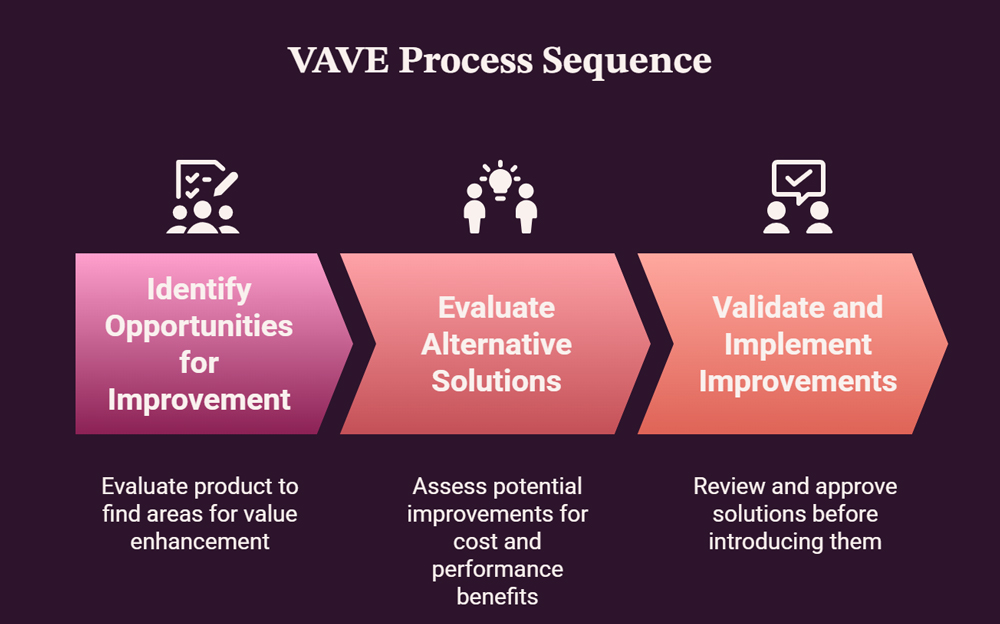
Image: The Three-Step VAVE Process: Identify, Evaluate, and Implement Improvements
VAVE follows a structured process to identify opportunities for improving product value while maintaining the required level of quality, functionality, and performance. Although the approach may vary between organisations, it generally involves three key stages.
Identify opportunities for improvement: The process begins by evaluating a product, component, or process to identify areas where value can be improved. This may include reviewing product design, material selection, manufacturing methods, production costs, or supply chain considerations.
Evaluate alternative solutions: Potential improvements are then assessed to determine whether they can reduce costs, improve manufacturability, enhance product performance, or simplify production without compromising the product's intended function.
Validate and implement improvements: Before changes are introduced, proposed solutions are reviewed and validated to ensure they continue to meet quality, performance, and business requirements. Once approved, the improvements are implemented and monitored as part of the organisation's continuous improvement efforts.
VAVE can be applied throughout the product lifecycle to improve value while maintaining quality, functionality, and manufacturability. It may involve optimising product designs, materials, manufacturing processes, and supply chain strategies to deliver greater value.
Optimising product designs early helps reduce manufacturing complexity and improve production efficiency.
This may involve simplifying product designs, reducing the number of components, or applying Design for Manufacturability (DFM) principles to make products easier and more cost-effective to manufacture without affecting their intended function.
Selecting the right components and materials plays an important role in improving product value.
Through VAVE, manufacturers may evaluate alternative components, material substitutions, or updated technologies that offer comparable performance while improving cost efficiency, availability, or long-term product support.
This approach can also help address component obsolescence and strengthen supply chain resilience.
VAVE extends beyond product design by evaluating how products are manufactured.
Manufacturers may identify opportunities to improve production workflows, simplify assembly processes, optimise PCB layouts, or reduce manufacturing waste. These improvements can help increase production efficiency while maintaining consistent product quality.
Supply chain considerations are an important part of VAVE.
Evaluating supplier options, sourcing strategies, and component availability helps reduce procurement risks and improve production continuity. Where appropriate, manufacturers may identify alternative suppliers or equivalent components to minimise lead times and improve supply chain flexibility.
Any changes introduced through VAVE should continue to meet product quality and performance requirements.
Testing/inspection and product validation help verify that design improvements, component changes, or manufacturing adjustments maintain the required levels of functionality, reliability, and compliance before implementation.
Improving product value requires more than identifying opportunities to reduce costs. It also requires the engineering expertise, manufacturing capabilities, and supply chain knowledge to implement improvements while maintaining quality, functionality, and reliability.
At Flexi Versa Group, we apply VAVE principles throughout the product lifecycle to help customers improve product value.
Our engineering and manufacturing teams evaluate product designs, manufacturing processes, component selection, and supply chain strategies to identify opportunities for optimisation while maintaining quality, functionality, and reliability.
Our integrated capabilities support VAVE initiatives across multiple areas, including:
Printed Circuit Board Assembly (PCBA) for design optimisation and manufacturing efficiency
Box Build to simplify product assembly and system integration
Testing & Inspection to validate design changes and maintain product quality
Supply Chain Solutions to improve component sourcing and long-term availability
By combining engineering expertise with integrated manufacturing capabilities, we help customers improve product value while supporting a smoother transition from product development to production.
Full Box Build Experience: See How Flexi Versa Group Applied VAVE to Optimise Costs and Support Product Development.
VAVE can be applied throughout the product lifecycle. Value Engineering is typically used during product development, while Value Analysis is used after production to identify opportunities for continuous improvement.
No. VAVE aims to improve overall product value by balancing cost, quality, functionality, manufacturability, and performance rather than focusing solely on cost reduction.
VAVE is widely used across industries such as electronics manufacturing, medical devices, industrial equipment, automotive, consumer electronics, and IoT, where continuous product improvement and cost optimisation are important.
The earlier VAVE is introduced, the greater its potential impact. Applying Value Engineering during product design can help optimise costs and manufacturability before production, while Value Analysis supports ongoing improvements after a product has been launched.
Yes. VAVE aims to improve value without compromising quality. Proposed improvements are evaluated to ensure they maintain or enhance product functionality, reliability, and performance.
Yes. VAVE helps improve supply chain resilience by evaluating alternative components, materials, and sourcing strategies that reduce supply risks while maintaining product quality and performance.
No. VAVE is an ongoing process of continuous improvement. Organisations can apply it throughout the product lifecycle to respond to changing customer needs, market conditions, and supply chain challenges.
As products become more complex and market demands continue to evolve, organisations need effective strategies to improve value without compromising quality, functionality, or performance.
Value Analysis & Value Engineering (VAVE) provides a structured approach to achieving this by identifying opportunities to optimise product designs, manufacturing processes, materials, and sourcing strategies throughout the product lifecycle.
Whether supporting new product development or improving existing products, VAVE helps organisations reduce unnecessary costs, enhance manufacturability, and deliver greater long-term value to customers.
Contact us to discover how we help organisations improve product value through engineering expertise, manufacturing excellence, and integrated supply chain support.