resources
What is Electronics Manufacturing Services (EMS)?
/)

EMS stands for Electronics Manufacturing Services. It refers to the range of engineering, manufacturing, assembly, testing, integration, and supply chain services provided by a specialist manufacturing partner to Original Equipment Manufacturers (OEMs).
Instead of investing heavily in their own manufacturing infrastructure, equipment, engineering resources, and supply chain networks, OEMs can work with an EMS provider to develop and manufacture their electronic products more efficiently.
For Flexi Versa Group (FVG), EMS goes beyond simply assembling printed circuit boards. As a vertically integrated EMS provider, FVG supports customers across the product lifecycle — from Design for Manufacturing (DFM) and engineering support to SMT and PCBA, testing, precision injection moulding, component manufacturing, and full box-build integration.
An EMS company acts as an extension of an OEM's engineering and manufacturing team.
Depending on the product and industry requirements, an EMS provider may support:
Product and manufacturing engineering
Design for Manufacturing (DFM)
Prototyping and New Product Introduction (NPI)
PCB assembly and SMT manufacturing
Electronics assembly and testing
Cable and wiring integration
Precision injection moulding
Component manufacturing
Mechanical assembly
Box-build and system integration
Product testing and validation
Component sourcing and supply chain management
Product lifecycle and obsolescence management
Final assembly, packaging, and logistics
The goal is to provide OEMs with a more integrated path from product concept to commercial production. See FVG's full range of manufacturing capabilities.
An OEM, or Original Equipment Manufacturer, typically owns the product design, intellectual property, brand, and customer relationship.
An EMS provider, on the other hand, provides the engineering and manufacturing capabilities needed to turn that product into a finished product.
The relationship can range from straightforward PCB assembly to a comprehensive manufacturing partnership covering engineering, components, electronics, mechanical parts, assembly, testing, and supply chain management.
For complex products, this integrated approach can reduce the number of suppliers an OEM needs to manage while improving communication, quality control, and time-to-market.
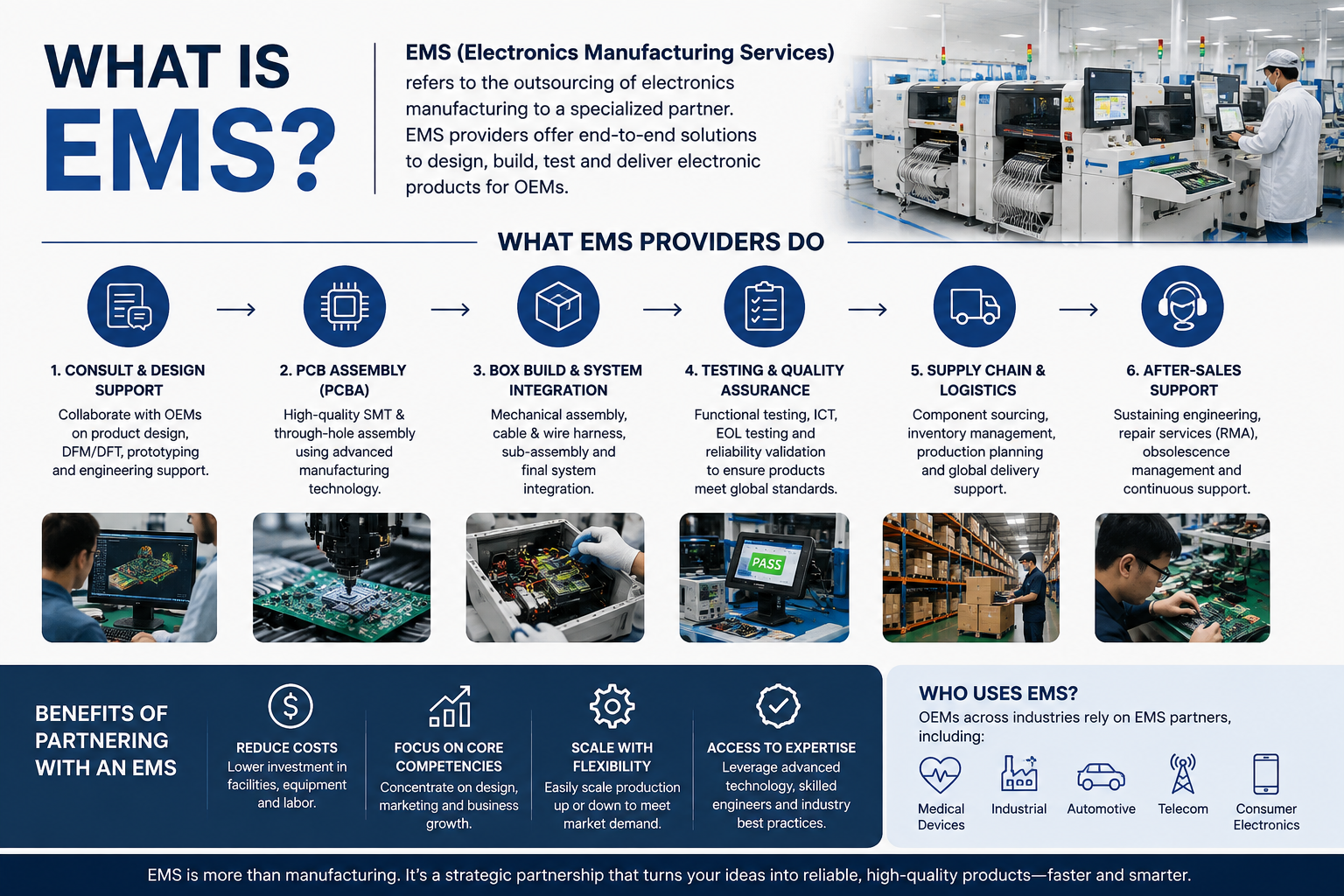
Manufacturing electronics requires significant investment in equipment, technology, engineering expertise, quality systems, skilled employees, and supply chain infrastructure.
Outsourcing allows OEMs to access these capabilities without having to build everything internally.
The major benefits can include:
OEMs can reduce the need to invest in expensive manufacturing equipment, production facilities, and specialised technologies.
An experienced EMS partner can support product development, DFM, NPI, and production ramp-up, helping companies move from design to manufacturing more efficiently.
EMS providers bring specialised knowledge of electronics assembly, testing, quality control, production engineering, and supply chain management.
Manufacturing requirements can change quickly. A flexible EMS partner can support product revisions, changing volumes, and different product configurations.
An experienced EMS provider can help manage components, suppliers, procurement, logistics, and other aspects of the manufacturing supply chain.
OEMs can scale production without having to continuously expand their own manufacturing infrastructure.
Flexi Versa Group's approach to EMS is built around vertical integration.
Rather than focusing only on electronics assembly, FVG combines multiple manufacturing capabilities within an integrated manufacturing ecosystem. These include:
Design for Manufacturing
Test development and validation
Precision injection moulding
SMT assembly
PCB assembly
Electronics manufacturing
Component manufacturing
Full box-build integration
Supply chain support
This integrated model enables customers to work with a single manufacturing partner across multiple stages of the product lifecycle.
FVG also operates a low-to-medium-volume, high-mix manufacturing model, which is particularly suited to products requiring flexibility, engineering support, and multiple configurations rather than purely high-volume production. Learn more about FVG.
EMS is used across a wide range of industries where electronic and electromechanical products are required.
At Flexi Versa Group, key industries include:
Medical products require high levels of quality, reliability, traceability, and manufacturing discipline. FVG provides integrated manufacturing capabilities supporting medical-related products, including electronics, plastics, and system integration.
Semiconductor-related equipment often involves complex electronic, mechanical, and precision components. Integrated manufacturing capabilities can help simplify supplier management and product assembly.
Industrial and clean-tech products can include energy management equipment, industrial control systems, renewable energy products, smart meters, and connected industrial technologies. FVG supports these applications through PCBA, box build, moulding, system integration, and supply chain capabilities.
Connected products often combine electronics, sensors, communications technology, mechanical components, and software-enabled systems. EMS partners can help bring these different manufacturing requirements together.
Telecommunications and networking products require reliable electronics manufacturing, assembly, testing, and supply chain support.
High-mix, low-volume (HMLV) manufacturing refers to producing a wide variety of products or product configurations, typically in relatively smaller quantities.
This is different from traditional mass production, where the objective is to manufacture very large quantities of a small number of standardised products.
High-mix manufacturing requires:
Flexible production processes
Strong engineering support
Effective material management
Accurate production planning
Robust quality systems
Efficient changeover processes
Strong traceability
Responsive customer communication
For OEMs producing complex products or products with multiple configurations, the ability to manufacture flexibly can be more important than simply achieving the highest possible production volume.
FVG's manufacturing model is specifically designed around low-to-medium-volume, high-mix requirements, supporting customers that need flexibility, technical expertise, and scalable production.
Selecting an EMS provider is an important strategic decision. The right partner should be able to support not only today's manufacturing requirements but also the product's future development.
OEMs should consider questions such as:
Look beyond PCB assembly. Consider whether the provider can support the complete product, including electronics, mechanical components, plastics, wiring, box build, testing, and system integration.
An EMS provider should be able to identify potential manufacturing issues early in the product development process.
Quality, traceability, and process control are particularly important for regulated and high-reliability industries.
Product designs, volumes, components, and customer requirements can change. Flexibility and responsiveness are therefore important characteristics of an EMS partner.
A good manufacturing partner should be capable of supporting the transition from prototype and NPI through production ramp-up and ongoing manufacturing.
The more manufacturing processes that can be integrated under one partner, the fewer handoffs and coordination points an OEM may need to manage.
Vertical integration can provide significant advantages for complex products.
When electronics, plastics, components, assembly, and testing are managed through an integrated manufacturing ecosystem, communication between different manufacturing processes can become more streamlined.
For the OEM, this can mean:
Fewer supplier interfaces
Better coordination between engineering and manufacturing
Greater visibility across the product lifecycle
Faster response to engineering changes
Improved supply chain coordination
Reduced handoffs between suppliers
More efficient product development and production
This is a key part of Flexi Versa Group's EMS proposition: combining different manufacturing disciplines to provide customers with a more complete manufacturing solution.
The electronics manufacturing industry continues to evolve as products become more connected, complex, and customised.
Several trends are shaping the future of EMS:
Automation, advanced production equipment, and data-driven manufacturing are increasingly important for improving consistency, efficiency, and productivity.
Global supply chain disruptions have highlighted the importance of supplier diversification, regional manufacturing capabilities, and robust component management.
Modern products increasingly combine electronics, mechanical components, software, connectivity, and advanced materials. EMS providers therefore need broader engineering and manufacturing capabilities.
Manufacturers are under increasing pressure to reduce energy consumption, waste, and environmental impact.
Flexi Versa Group has positioned sustainability as an important part of its manufacturing strategy, including solar-powered facilities, energy-efficient operations, and initiatives aimed at reducing environmental impact.
As customers demand more customised products and shorter product lifecycles, flexible high-mix manufacturing capabilities are becoming increasingly valuable.
Electronics manufacturing is no longer simply about assembling components onto a PCB.
Today's EMS partners can play a much broader role — helping OEMs improve product manufacturability, manage components, integrate electronics and mechanical parts, conduct testing, manage production, and support the supply chain.
For companies developing complex electronic or electromechanical products, choosing the right EMS partner can have a direct impact on quality, cost, flexibility, scalability, and time-to-market.
Flexi Versa Group combines more than 30 years of electronics manufacturing experience with vertically integrated manufacturing capabilities and a customer-focused approach.
From DFM and engineering through SMT, PCBA, precision moulding, component manufacturing, testing, and full box-build integration, FVG provides a comprehensive manufacturing platform for customers across medical, semiconductor, industrial, clean technology, IoT, and other technology-driven industries.
For OEMs looking for more than a traditional contract manufacturer, Flexi Versa Group provides an integrated manufacturing partnership designed to help bring complex products from concept to production and beyond.
Flexi Versa Group — Powering Innovation with Manufacturing Excellence.