resources
Design for Manufacturing (DFM): Guide to Cost Optimisation in New Product Introduction (NPI)
/)

Key takeaways:
Design for Manufacturing (DFM) is an engineering methodology that improves manufacturability by considering production requirements early in product development.
Applying DFM during New Product Introduction (NPI) helps reduce manufacturing costs, minimise redesigns, and accelerate time to market.
The five principles of DFM focus on manufacturing processes, product design, material selection, operating conditions, and regulatory compliance.
DFM supports each stage of NPI, from Engineering Validation Test (EVT) through Design Validation Test (DVT) and Production Validation Test (PVT).
Combining Design for Manufacturing (DFM) and Design for Assembly (DFA) helps organisations improve production efficiency while maintaining product quality and performance.
Flexi Versa Group applies DFM through its integrated capabilities to help customers optimise designs and achieve a smoother transition to production.
Bringing a new product to market involves more than creating an innovative design. It also requires ensuring that the product can be manufactured efficiently, consistently, and cost-effectively.
Design for Manufacturing (DFM) is an engineering methodology that incorporates manufacturing considerations early in the design process to simplify production, reduce costs, and improve product quality. Rather than identifying manufacturing issues after a design has been completed, DFM helps prevent costly redesigns before production begins.
As a key part of New Product Introduction (NPI), DFM enables businesses to optimise product designs, improve manufacturability, and support a smoother transition from development to mass production.
Design for Manufacturing (DFM) is an engineering methodology that focuses on designing products that are easy, efficient, and cost-effective to manufacture.
Early consideration of manufacturing processes, material selection, assembly methods, and production requirements helps reduce production complexity while maintaining product quality, functionality, and performance.
Rather than treating manufacturing as the final step, DFM integrates manufacturing considerations into product design from the beginning, helping minimise production risks and improve overall product value.
Implementing DFM early in product development helps businesses identify manufacturing challenges before production begins.
Applying DFM can help organisations:
Reduce manufacturing costs
Improve manufacturability and production efficiency
Minimise redesigns and production delays
Improve product quality and consistency
Accelerate time to market
Addressing manufacturing requirements early helps support a more efficient product development process while reducing the risk of costly changes later.
Although Design for Manufacturing (DFM) and Design for Assembly (DFA) are closely related, they focus on different aspects of product development.
DFM focuses on designing products that are easier and more cost-effective to manufacture by considering production processes, materials, and manufacturing requirements.
DFA, on the other hand, focuses on simplifying product assembly by reducing part counts, eliminating unnecessary assembly steps, and improving assembly efficiency.
When applied together, DFM and DFA help organisations improve manufacturability, reduce production costs, and support higher product quality throughout the manufacturing process.
Also read: Design for Assembly (DFA): Guide to Cost Optimisation in New Product Introduction (NPI).
Applying Design for Manufacturing (DFM) starts with understanding its five core principles. Together, these principles help organisations design products that are easier to manufacture, more cost-effective to produce, and better suited for scalable production.
Different manufacturing processes have different design requirements. For example, products designed for Precision Plastic Injection Moulding should consider factors such as wall thickness, draft angles, rib design, and material flow to improve manufacturability and reduce production defects. Considering these requirements early helps support efficient, high-volume production.
Simple product designs are generally easier and more economical to manufacture. Reducing unnecessary features, minimising part counts, and designing components for efficient assembly can help lower production costs while improving manufacturing consistency.
Material selection should balance performance, manufacturability, availability, and cost. Selecting appropriate materials and standardised components early in the design process can improve production efficiency while reducing procurement risks and unnecessary material costs.
Products should be designed to perform reliably in their intended environment. Factors such as temperature, humidity, vibration, corrosion, and mechanical stress should be considered during development to improve long-term product reliability and reduce the risk of failures.
Products should comply with relevant industry standards, regulatory requirements, and quality expectations from the outset. Addressing compliance early helps minimise redesigns, simplify validation activities, and support a smoother transition into production.
Related insights: Design for Manufacturability (DFM): Turning Good Designs into Manufacturable Products.
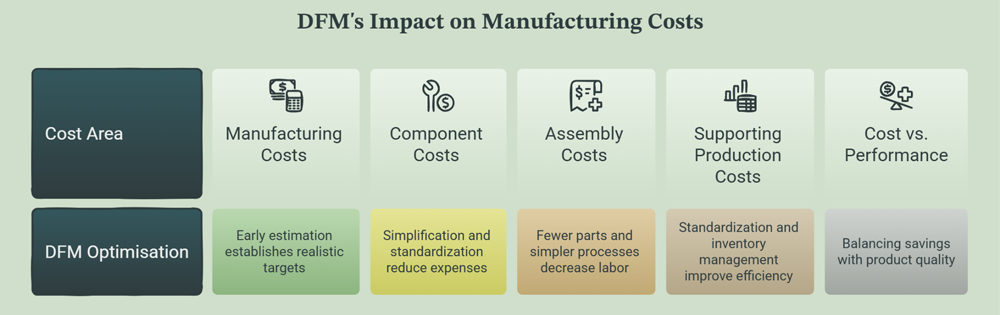
Image: Impact of DFM on Manufacturing Costs
One of the primary objectives of DFM is to reduce manufacturing costs without compromising product quality or functionality. Evaluating product designs before production begins allows organisations to identify opportunities to improve efficiency and eliminate unnecessary costs.
Understanding manufacturing costs during the design stage helps establish realistic cost targets and identify opportunities for optimisation before production begins. This includes evaluating material costs, tooling, labour, production processes, and overheads.
Simplifying component designs, selecting standard parts, and avoiding unnecessary complexity can help reduce production costs. Where appropriate, organisations may also consider alternative materials or components that deliver the required performance at a lower overall cost.
Products with fewer components and simpler assembly processes generally require less manufacturing time and labour. Designing products that are easier to assemble can improve production efficiency while reducing the likelihood of assembly errors.
Manufacturing costs extend beyond materials and assembly. Standardising components, simplifying inventory management, and reducing inspection or handling requirements can improve operational efficiency and lower overall production costs.
Cost optimisation should never compromise product functionality, quality, or reliability. DFM encourages organisations to evaluate design decisions carefully, ensuring cost savings are balanced with product performance, durability, and customer expectations.
Design for Manufacturing (DFM) supports every stage of the New Product Introduction (NPI) process, helping organisations identify manufacturing issues early, reduce redesigns, and prepare for efficient production.
During the Engineering Validation Test (EVT), DFM is used to assess whether the initial product design can be manufactured efficiently. Early reviews help identify potential issues related to materials, component selection, manufacturing processes, and assembly, allowing design improvements before prototypes are refined.
During Design Validation Test (DVT), DFM focuses on refining the product design using feedback from prototype builds. This stage helps optimise assembly methods, improve production yield, and address any remaining manufacturability issues before the design is finalised.
During Production Validation Test (PVT), DFM helps confirm that the product can be manufactured consistently using the intended production processes. Validating work instructions, tooling, and manufacturing workflows reduces production risks and prepares the product for full-scale manufacturing.
Also read: EVT, DVT, and PVT: Product Development Stages in EMS Explained.
Design for Manufacturing (DFM) is most effective when manufacturing considerations are incorporated early in product development. By evaluating product designs before production begins, businesses can identify opportunities to simplify manufacturing, improve assembly efficiency, optimise material selection, and reduce unnecessary production costs.
This collaborative approach also helps minimise redesigns, improve production readiness, and support a smoother transition from development to manufacturing.
At Flexi Versa Group, DFM principles are applied across product design reviews, manufacturing planning, testing and inspection, and supply chain management to help customers develop products that are designed for efficient, scalable production.
Design for Manufacturing should be implemented as early as possible during product design. Addressing manufacturing considerations early helps reduce redesigns, improve manufacturability, and minimise production costs before manufacturing begins.
Without DFM, products may be more difficult and expensive to manufacture, resulting in higher production costs, longer lead times, design revisions, and manufacturing inefficiencies.
Yes. DFM helps reduce manufacturing costs by simplifying product designs, reducing component and assembly complexity, selecting appropriate materials, and improving manufacturing efficiency.
DFM is widely used across industries including medical devices, industrial manufacturing, Internet of Things (IoT), semiconductor, telecom & networking, automotive, and consumer products to improve manufacturability and support efficient production.
Yes. By considering manufacturing requirements during product design, DFM helps reduce production defects, improve manufacturing consistency, and support higher product quality.
DFM helps shorten time to market by identifying manufacturing issues early, reducing redesigns, improving production readiness, and supporting a smoother transition from product development to mass production.
As products become more complex and customer expectations continue to evolve, businesses need design approaches that support efficient manufacturing without compromising quality, functionality, or performance.
Design for Manufacturing (DFM) provides a structured approach to achieving this by considering manufacturing requirements early in product development.
This enables organisations to optimise product designs, materials, and production processes before manufacturing begins, reducing costs, improving manufacturability, and accelerating New Product Introduction.
From medical devices and industrial equipment to IoT solutions and telecommunications products, DFM plays an important role in helping organisations bring high-quality products to market more efficiently.
Contact us to discover how we help with efficient product development through Design for Manufacturing, helping transform manufacturable designs into production-ready products.